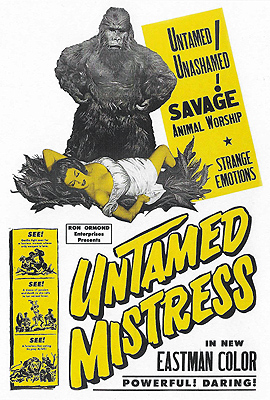
 Untamed Mistress (1956) -**½
Last year, we had our first encounter with Ron Ormond when I reviewed If Footmen Tire You, What Will Horses Do? That film came relatively late in Ormond’s career, however— indeed, it came after his first retirement, following a near-death experience that scared him temporarily out of showbiz, and into the arms of screwball Deep South preacher Estus W. Pirkle. There’s plenty more crazed cinematic God-bothering where it came from, but before we delve any further into that phase of Ormond’s strange creative journey, let’s see what kind of filmmaker he was before he got religion. I don’t propose to go all the way back to the beginning, because bargain-basement Westerns aren’t any of my things, but Untamed Mistress gets us pretty close to ground zero while simultaneously offering a much clearer picture of what a peculiar director Ormond was and would become.
Untamed Mistress is three different kinds of utter fucking nonsense, and although I do possess the background information necessary to render it somewhat intelligible, I think it’ll be more fun if I start by dropping it on you the way I initially experienced it, mostly unencumbered by context. Arthur (Allan Nixon, from Siren of Atlantis and Prehistoric Women) and Jack (Mesa of Lost Women’s John Martin) are brothers traveling together in what we’re asked to believe is Darkest Africa (although Darkest Griffith Park seems rather more likely). The former is a medical doctor and professional international do-gooder, while the latter is a sailor if we may judge by his mode of dress. They’re accompanied by two men and a woman: a sawed-off little weirdo called Cyril (Cliff Taylor, who played doctors or barkeeps in most of Ormond’s Lash La Rue vehicles); a jungle guide of rather surprising Indian origin, known as Parsta (the self-evidently non-Indian Byron Keith); and a curvaceous, fun-size firecracker by the name of Velda (Jacqueline Fontaine). The girl is Jack’s fiancée, whom he picked up on this very trip, and none of his companions are happy about that. Right now, though, the party has a more pressing concern, for Parsta has been mauled by an extraordinarily crummy fur-suit gorilla, and his condition is beyond anything that Arthur could do for him outside of a hospital. Parsta himself, however, is strangely convinced that his impending death is relevant to the situation with Jack and Velda. Permit him to explain…
Years and years ago, back in his native land, Parsta was no mere jungle guide. He was a maharaja, and had a reputation as one of the greatest big-game hunters in all India. But one day he went hunting in the company of his henchman, Kurran (Don Harvey, of The Man Who Turned to Stone and Creature with the Atom Brain, who wasn’t an Indian either), whose prowess in the chase supposedly equaled or surpassed his own. Although Kurran assured the maharaja that game of all sorts abounded in the forest he had chosen as the venue for their hunt, nary a critter showed its face throughout the entire day, so that Parsta grew increasingly annoyed. Eventually, the expedition came upon the hermitage of a lama (Nelson Leigh— yet a third unmistakable honky in brownface), who explained that those woods were under the protection of someone or something called Sabu. The animals had all been taught to recognize humans who meant them harm, and to lie low whenever such miscreants intruded upon the peace of the forest. For all their skill, Parsta and Kurran would do no hunting there. Parsta quickly conceived a new objective, however, for the lama was attended by a beautiful yet strangely wild girl called Rani (Carol Varga, from Bride of the Gorilla and Dyesebel, who may not be Indian, but is at least Filipina). She’d have made a fine addition to the royal harem, but she was betrothed to another, and Parsta’s riches and rank made no impression on her. Nor did a devious scheme to detach Rani from her beloved by faking the man’s death avail the maharaja anything, and his efforts to claim her by force backfired so spectacularly that the erstwhile ruler of men lost everything, and wound up roaming the Earth’s wildernesses under an unspecified curse. Note, however, that the flashback sequence breaks off without showing any of that, while Parsta’s concluding narration elides every potentially interesting detail. What has any of this to do with Jack and Velda, you ask? Well, Parsta is convinced that the gorilla attack he suffered a little while ago was the fulfillment of the doom he incurred while pursuing Rani, and the lesson he has learned too late for it to do him any good is that civilized men should stay the fuck away from jungle girls. Velda, he’s certain, has more of the jungle in her than Rani ever did!
Be that as it may, the safari party forges on ahead just as soon as Parsta is buried, bound for the unexplored region of the jungle where Velda was born. Yes, you’re quite right. There is indeed something fishy in the notion of this Latin-looking girl supposedly hailing from territory in Equatorial Africa where even the native tribes prefer not to venture, but Arthur has a theory about that. He thinks Velda might be the daughter of two husband-and-wife explorers who disappeared twenty years ago in an attempt to penetrate the very same patch of jungle. And if Arthur is right, then Parsta’s slanderous condemnation of Velda as having been raised by gorillas could in fact be the plain, literal truth, for there’s no one in that country to rescue or care for a human infant except for the indigenous apes. (Velda herself has remained pointedly silent on all but the strictly geographical aspects of her background.) The doctor seems to hope that Jack will feel like a monkey’s uncle if he can prove that Velda was a monkey’s niece.
Whatever Arthur’s actual aims, however, they get derailed at a village on the edge of terra incognita. Untamed Mistress gets derailed there, too, by an incontinent eruption of travelogue footage credited to one Arthur Trevenning Harris, MD (who counted Mickey Rooney among his patients, if Ormond’s wife, June, is to be believed). Arthur, Jack, and Cyril are content enough to enjoy the spectacles of sparring warriors, competitive ritual dances, and bare-breasted tribal maidens going toplessly about their otherwise uninteresting business, but the outsiders attract the notice of a white trader called Nairobi Smith (your guess as to who played him is as good as mine), who is said to detest his own race. Smith’s intrigues against Arthur and his party are just one problem among several, however, for all the hubbub in the village is building toward a ceremony of human sacrifice in which one of the aforementioned maidens is offered in tribute to the gorillas of the neighboring jungle. You see, the unspeakable secret of Gorilla Country is a clearing in the depths of the forest where a tribe of apes in suits that you might recognize from White Pongo live in blissful interspecies fornication with every black stripper Ormond could find whose self-respect could be bought at a price that would fit within this movie’s budget. And yes— these apes and their human mates did indeed raise Velda from infancy, and their leader now hopes to find her willing to play Fay Wray to his King Kong.
If you get the feeling that Untamed Mistress was never really meant to be a single, coherent film, you’re absolutely right. It’s hard to be certain just what happened, though, because the standard account of its genesis doesn’t square with the handful of dates that can be solidly pinned down. It’s immediately obvious, watching the film, that it was made in at least three layers: the main narrative about the quest for Velda’s origins, Parsta’s deathbed flashback to his pursuit of Rani, and the nonfiction footage actually shot in Africa. And it’s similarly obvious that each stratum was originally made for its own separate purpose, although it takes some digging to uncover just how separate those purposes really were.
To begin with, I call your attention to the strangest feature of the flashback story, the jungle guardian who is namedropped frequently, but never appears onscreen. If the name Sabu sounded familiar to you, that’s because we’re talking about Sabu Dastagir, the Sabu of Cobra Woman and The Thief of Bagdad. Despite his seemingly firm position as a B-list star throughout the first half of the 1940’s, Sabu descended rapidly into has-been-hood after the war, to the point that even the lowliest of independent producers could afford him by the 1950’s. He even made a three-reeler called The Black Panther for Howco International, the company that Ron Ormond formed in partnership with theater owners Joy N. Houck and J. Francis White! When Parsta flashes back to the tale of Rani, he’s really flashing back to The Black Panther— but Howco would have had to pay Sabu for a second picture if they reused any of the scenes in which he appeared. They didn’t want to do that, which is why the dying maharaja can only tell us about what ultimately befell him back in India.
So far, so loony— but still basically intelligible, right? The confusion arises because Untamed Mistress was released in 1956, but The Black Panther didn’t come out until 1957. Furthermore, Untamed Mistress bears a copyright date of 1953, yet the seemingly well-researched liner notes to Indicator’s Ron Ormond box set, From Hollywood to Heaven, claim that it was shot as early as 1951. So what really happened here? I don’t know, but my hypothesis is that Ormond started work on a jungle adventure picture in 1951, but never finished it. Then in 1953, he saw Arthur Trevenning Harris’s African vacation movies (maybe Harris was Ormond’s doctor, too), and realized that he could use them to salvage the jungle flick by transforming it into a hybrid goona-goona/nudie. If so, that would imply the later date for the girls-and-gorillas scenes as well. That notional “completed” version of Untamed Mistress would still have been less than an hour long, though, which would explain why even Ormond’s own partners wouldn’t have wanted to release it at the time. Finally, once The Black Panther was in the can, Ormond could raid it for non-Sabu footage to bulk up Untamed Mistress to 72 minutes, and then sit on the short until Howco needed an opening act for some other picture. I can’t prove that this is how it went down, but it would reconcile the apparent contradictions in this movie’s origin story.
The mere fact that Untamed Mistress invites such speculation should be enough to tell you that it’s a tangled, nonsensical mess of a movie. Ormond just barely pretends to make any connection between the Black Panther material and the main ostensible plot, and his contractual inability to use any of the footage in which the flashback storyline is resolved renders the entire digression doubly pointless. Nor does it help that the flashback comes before Ormond has even established what the premise of Untamed Mistress is going to be. We never learn why Arthur and Jack came to Africa in the first place, and the latter’s bond with Velda has no discernable motive or origin. We don’t see the couple meet, and all we’re ever told about the circumstances in which they did is that it happened quite recently, during the course of the brothers’ safari. Also, although I’m sure nobody who saw the film back in 1956 cared about this, the modern viewer can’t help but notice that Arthur has no basis for objecting to the relationship beyond sheer asshole bigotry. Just what one likes to see in a protagonist, right? Then again, we are doing “black girls and gorillas are horny for each other” here, so I guess we shouldn’t be surprised to see other, lesser forms of unexamined racism put in an appearance. All in all, I can’t believe that of the two Ron Ormond movies I’ve seen so far, If Footmen Tire You, What Will Horses Do? is not only the less reprehensible, but also the one that felt more like the work of people who gave a shit.

Home Alphabetical Index Chronological Index Contact
