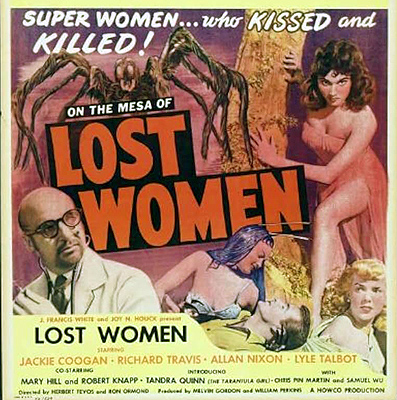
 Mesa of Lost Women / House of Lost Women / Lost Women / Attack of the Spider Women (1953) -**
I have very little idea who Herbert Tevos was. At this late date, I rather doubt that anyone else knows much more about him than I’ve been able to piece together, either— especially since Tevos’s status as a consummate bullshitter comes through loud and clear in those anecdotes about him that have been recorded here and there. For instance, he reportedly liked to tell people that he had been an important director of motion pictures back in his native Germany, but no actual credit of his has ever turned up on that side of the Atlantic. Tevos sure as hell didn’t direct The Blue Angel, which was the film he supposedly cited whenever someone asked him to name a highlight of his career! That being so, I think we should also look with suspicion on the tales he told his friends from the Rochester Institute of Technology (where Tevos had contacts via his job with the New York branch of the German photography supply company, Agfa) about having known Manfred “the Red Baron” von Richthofen, or being the sole survivor of a doomed expedition into the Amazon jungle. The one thing we can be really sure of about Tevos, and the reason why we’re talking about him right now, is that in 1951, he wrote and directed a junky little mad-science flick called Tarantula.
No, not that Tarantula. Tevos’s Tarantula was something completely different, although its post-completion fate makes it difficult to reconstruct exactly what. It doesn’t matter all that much, I guess, because when the producers could find no distributor willing to release the film, they sold it to Howco on a cash-and-carry, “it’s your problem now” basis. No one in Howco’s leading triumvirate thought Tarantula was releasable, either, but remember that the first “O” in Howco was Ron Ormond. Ormond had been cranking out cheap crap of his own at an incredible pace since 1948, and he reckoned that a couple weeks’ worth of reshoots, some judicious recutting, and some voiceover narration to spackle the seams would be enough to render Tevos’s movie fit for the drive-in, so long as nobody expected to get rich off of it. By the time 1953 rolled around, Tarantula was no more, and in its place stood Mesa of Lost Women.
For a long time, B-movie lore had Mesa of Lost Women incorrectly pegged as an uncredited Ed Wood project, and the narration that washes over us in the opening scene (not counting a short, extraneous prologue that not all prints have anyway) is a big part of the reason why. For one thing, it’s delivered by Lyle Talbot, whom Wood employed in both Glen or Glenda? and Plan 9 from Outer Space. But it’s also exactly the kind of loony, overwrought shit that Wood was forever writing:
Strange, the monstrous arrogance that this weak race of bipeds shows, with an oversized ego, and who call themselves “men.” She believes that the Earth belongs to her, and that other creatures exist only for her. What a stupid race! |
Talbot goes on in that vein for quite a while as freelance pilot Grant Phillips (Robert Knapp) and unexploded blonde bombshell Doreen Culbertson (Paula Hill, of The Beast from 20,000 Fathoms) trudge across the inhospitable Muerto Desert— and then he caps off the building hilarity by pronouncing the name of the place “Mew-AIR-toe.” Grant and Doreen are nearly at the end of their rope when they fortuitously encounter oil prospector Dan Mulcahy (Richard Travis, from Cyborg 2087 and Missile to the Moon) and his Mexican sidekick, Pepe (Chris-Pin Martin, of Ali Baba and the Forty Thieves, who was something of a regular in Ormond’s late-40’s Westerns). Dan bundles the ailing pair into his jeep, and drives them to his firm’s field office, where company physician Dr. Tucker (Allan Nixon, from Untamed Mistress and Siren of Atlantis) can treat them for dehydration and heat exhaustion. Phillips regains consciousness first, but calls his sanity into question by flying immediately into hysterics about the need to destroy some nest of monsters “before they scatter.” When he identifies the site in question as Zarpa Mesa, however, and names a certain Dr. Aranya in connection with his supposed “super-bugs,” Mulcahy, Tucker, and Pepe alike become at least slightly more willing to hear him out. Both of those names are well known locally, and neither of them has a savory reputation.
Naturally that’s our cue for a flashback. At least at first, though, it isn’t the flashback you’d logically expect. In fact, it starts off being a flashback that none of the characters present should even be capable of having! No, this flashback rightly belongs to a brand new character, a scientist by the name of Dr. Leland Masterson (Harmon Stevens). Some time ago, Masterson read a paper on insect endocrinology by the aforementioned Dr. Aranya (Uncle Fester himself, Jackie Coogan, whom we’ve seen before in The Space Children and The Prey), and was so fascinated that he contacted Aranya at once to propose meeting to discuss his work. Of course, Masterson never imagined that the other scientist’s home and lab would sit on top of a shunned mesa in the middle of the Muerto Desert, or that the place would be staffed by strange-looking dwarf-men (notable among whom is Angelo Rossitto, from Fairy Tales and The Dark) and stranger-looking women in cornrow wigs. Aranya explained that his hangers-on were a new race of his own devising, created by dosing people (or perhaps human embryos?) with spider hormones. As peculiar a thing to do as that might be, it was only an intermediate stage in a much bigger project. Aranya had also been dosing spiders with hormones taken from his spider-people, in the hope of creating giant, intelligent bugs! Masterson decided at that point that he wanted nothing to do with any of this, but Aranya and his arachno-babes obviously weren’t just going to let him leave now that he knew what they were up to. They didn’t kill the newly troublesome scientist, but whatever they did to him instead rendered him incurably insane by the time they released him.
The next time we see Masterson (and we’re deep enough into Tarantula now that nobody’s making any effort to preserve the already tenuous flashback conceit), he’s a patient in what’s supposed to be a high-security mental hospital. Evidently not high enough, though, because the now-mad scientist has no difficulty escaping. Masterson flees into the surrounding city, where he eventually wanders into a nightclub and encounters someone whom we know from before the bogus flashback. Doreen Culbertson is there in company with her fiancé, wealthy businessman Jan Van Croft (Niko Lek), killing time while the pilot whom Croft chartered to fly them to their nuptials is getting his junkheap plane airworthy. Yes, that’s Grant Phillips we’re talking about, although it’ll be another scene or two before he reenters the film in person. Masterson instantly takes a liking to Doreen, and helps himself to one of the empty seats at the couple’s table. She and Jan have just about caught on that something about the interloper isn’t right when the fourth seat is claimed by George (George Barrows, of Frankenstein’s Daughter, who was inside the outer space gorilla suits in Robot Monster), a psychiatric nurse from the asylum where Masterson is supposed to be. George tries to bring Jan and Doreen up to speed as gently and subtly as he can, but before he can make much headway in steering the situation toward Masterson’s recapture, the loony realizes that he’s seen the floor show dancer before. Her name is Tarantella (Tandra Quinn, from Problem Girls and The Neanderthal Man), and she’s Dr. Aranya’s proudest achievement in the field of spider-girl manufacture. Masterson goes berserk, producing a pistol from the pocket of his overcoat, and gunning Tarantella down. And mad or not, he retains enough sense of self-preservation to hustle his three companions— now effectively his captives— out of the saloon before anyone else in the crowd catches on that the shooting wasn’t part of Tarantella’s already very strange performance. Mind you, the strangest part of all comes after the ensuing panic empties the place out, when Tarantella gets back up again, good as new. Aranya did say that his creatures possessed the spider’s ability to regrow lost limbs or to shrug off injuries that would be fatal to “higher” lifeforms…
Meanwhile, Masterson rather surprisingly lets himself be persuaded to head for the airfield where Grant Phillips is tinkering with his plane. The pilot still doesn’t think the machine is ready to fly, but Masterson’s .45 makes a convincing argument to the contrary. Of course that means that Phillips will have to ditch sooner or later, but that’s really only half of the problem for the pilot and his passengers. The other half is that Van Croft’s Chinese valet, Wu (Samuel Wu), happens to be an agent of Dr. Aranya, and he sees his false master’s run-in with his true one’s former prisoner as a chance to tie off some loose ends once and for all. Wu tampers with the aircraft’s compass so that the course Phillips intended to fly instead takes the party straight to Zarpa Mesa. And it is fortuitously right over Zarpa Mesa that the plane’s bum engine gives out. Phillips is forced to guide the vehicle into a controlled crash on top of the mesa, miraculously bringing it down without injury to anyone aboard. Alas, however, neither Tevos nor Ormond is able to exert a comparable degree of control over the crash that the movie itself undergoes at the same time.
Mesa of Lost Women stops virtually dead in its tracks upon the return to Dr. Aranya’s domain, and never you mind that there are still 32 minutes left on the clock (out of a paltry total of 69!). The rest of the film consists of little more than six people, most of whom increasingly dislike each other, arguing around a campfire while insert shots of Dr. Aranya’s creatures spy on them from the surrounding scrub-woods. Eventually, characters start wandering off one by one into the darkness to get killed— offscreen!!!!— by the mad scientist’s arachnoid monster. Finally, the last survivors are rounded up and taken to the lab for something vaguely climax-shaped, and Ormond at long last remembers that everything we’ve seen since Grant revived in Dr. Tucker’s office was supposed to be a flashback. It’s unendurable.
That sucks doubly, because I was quite enjoying this cracked little oddity up until then. I was even kind of digging the infamously mind-numbing score, which is a bit like a minimalist, flamenco-flavored cousin to the equally notorious “Torgo Walks” cue in Manos: The Hands of Fate. The suspicions of Ed Wood’s clandestine involvement were, as I said, understandable, but the schlockmeister whose work Mesa of Lost Women reminds me of more is Coleman Francis. The resemblance to Francis’s The Beast of Yucca Flats also begins with the outlandishly florid voiceover, but it truly makes itself felt in Mesa of Lost Women’s almost complete lack of narrative connective tissue. Things happen, and supposed reasons for their happening are put forward in the film, but the former rarely bear any logical connection to the latter. No doubt some of that is due to Ron Ormond making additions, subtractions, and alterations with zero fucks given for the integrity of Herbert Tevos’s vision, but integrity seems to be the very thing that Tarantula was most seriously missing in the first place. Indeed, to my considerable surprise, it isn’t at all apparent which particular bits of this celluloid refuse rightly belong to which director. In that sense if no other, this is a more successful job of cutting and pasting than Ormond would perform some years later in Untamed Mistress. That still leaves Mesa of Lost Women unsuitable for anyone but the most hardened cinemasochist, however.

Home Alphabetical Index Chronological Index Contact
