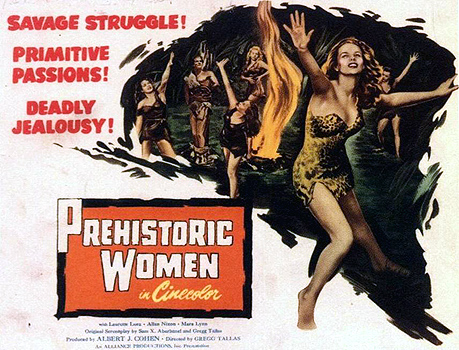
 Prehistoric Women / The Virgin Goddess (1950) -***
Somehow I never really thought about this before, but for normal people who watch (let alone make) normal movies, there probably isn’t any inherent attraction to prehistory as a setting. I say that because it suddenly occurs to me that I’ve seen very few caveman movies in which the era is used merely to create unusual challenges for characters engaged in timeless human undertakings like the pursuit of power or the creation of things that will outlast their lives. No, films set in the Stone Age tend to resolve themselves into just-so stories about the invention or discovery of some essential feature of society. For instance, the granddaddy of them all, One Million B.C., dramatizes the triumph of interpersonal cooperation and norm-based social organization over solipsistic brutality and the rule of violence. Ironmaster is about the invention of war and conquest. Quest for Fire is exactly what it says on the package. Even the exuberantly thick-headed When Dinosaurs Ruled the Earth wants to say something about religion’s rise out of the savagery of human sacrifice. But by far the most popular subject for movies set in prehistory is the primordial stage of relations between men and women. That’s a recognizable secondary theme in all of the aforementioned films, and it’s the central focus of plenty more. Sometimes the concept is played for laughs, like in The Wild Women of Wongo. Sometimes it’s meant more or less seriously, like in Clan of the Cave Bear. Occasionally it goes batshit insane, like in Adam and Eve vs. the Cannibals. And often it gets tangled up with the postmodern era’s anxieties over shifting gender roles, giving rise to chauvinist fables in which Victorian patriarchy is touted as an inescapable part of the natural order. That’s the kind of movie I was expecting Prehistoric Women to be, but I was only about half-right. Although Prehistoric Women does purport to tell the story of the opening skirmish in the Battle of the Sexes, it does so more evenhandedly than I anticipated— and if you disregard the incessant voiceover narration in favor of what’s actually shown onscreen, it spends much of the running time drifting toward a state of William Moulton Marston-ish fem-dom mania!
Unsurprisingly in light of the title, Prehistoric Women begins with a small, all-female tribe of Cro Magnons in the midst of an ecstatic nocturnal dance ritual. That sort of thing had been reckoned a dependable crowd-pleaser since the heyday of the goona-goonas in the early 1930’s, and far be it from the exploitationeers of 1950 to argue with success. It is perhaps a bit unusual, though, to have the narrator come right out and confirm that these rites are a method for burning off libidinal energies that have no other outlet in the absence of men. Regardless, once her younger fellows have danced themselves to exhaustion, the old shamaness (Janet Scott— definitely not to be confused with Janette Scott!) gives them all a lesson in tribal history:
Many years ago, when the present crop of 20-something cavegirls were little more than infants, their mothers belonged to a different tribe, with a more typical balance of the sexes. The men of that tribe were tyrants, however, and treated the women as slaves. One day, a woman named Tana (Jeanne Sorel), who was the mate of the chieftain (John Frederick— or alternately, John Merrick— of Killers from Space and The Alligator People), rose up against her mistreatment, and was joined in rebellion by most of the other young females. After ganging up on the chief and incapacitating him (one assumes that put an end to his career in politics right quick), the rogue women fled to the valley where their daughters still live today. There they learned to fend for themselves, inventing an ingenious array of tools, weapons, and stratagems to render masculine muscle superfluous. Indeed, the one challenge that Tana and her people never managed to best by virtue of their creativity was Guaddi (Johann Petursson), the savage, solitary giant who even now menaces their territory like an ambulatory natural disaster. But since Guaddi also seems to be precisely the thing that has deterred the men of the old tribe from tracking down the runaway women, he’s a risk that the latter consider well worth running.
It happens, however, that the tribe’s days of chronic sexual frustration are nearing an end. A hunting party from a neighboring valley— a hunting party of young men— has pursued a tiger into Tanadale and caught it in a panji pit. The scent of the tiger’s blood piques the nose of one of the panthers that the women use as attack animals, and the next thing the lead huntsman (Alan Nixon, of Untamed Mistress and Mesa of Lost Women) knows, he’s grappling for his life against a cat much smaller, but no less ferocious, than the one he and his companions just killed. Eventually the embattled man— call him Engor— manages to bash in the panther’s skull with a stone-headed mace, but by then he has an even bigger problem. The panther’s mistress, Tigri (Laurette Luez, from Siren of Bagdad and The Adventures of Hajji Baba), was leading a hunting party of her own, and those gals take stark exception to the slaying of their cat. Engor and his band immediately come under a hail of sling-stones, and the only reason why the boss-man himself gets away is because he gets knocked out so cold in the opening salvo that his assailants mistake him for dead in the aftermath. Tigri and her team take all the other intruders captive, marching them off to a life of unexpectedly comfortable servitude in their treehouse village.
Upon recovering, Engor slinks back to his people’s cave complex two or three valleys away, seething with thoughts of vengeance. Ironically, the only one in his tribe with sufficient mastery of local lore to point him toward the home base of the panther girls* is his mother, and he tellingly doesn’t even bother trying to recruit a new gang to help him on his quest. No one will be surprised, then, to see that Engor has a time of it on his return to the other valley. He gets chased by an angry elephant and menaced by a hungry python, loses his mace, burns his fingers while discovering fire, and then loses that as well when he dunks his newly made torch into a stream to see whether it illuminates the bottom. And after all that, Tigri kicks his ass a second time when they cross paths again, and drags him back to her treehouse to become her captive mate. Nevertheless, Engor isn’t quite as hapless as his adventures thus far have made him appear. He remembers what he did to make that flame, and he has little trouble repeating the trick. When the women’s village comes under attack from Corax the Flying Dragon (incredibly portrayed by a pelican with various Mesozoic gewgaws affixed to its head), Engor makes another torch and saves the day. It occurs to him then that if fire can chase off the bullshittiest giant pterosaur that anyone ever saw, maybe it can also turn the tables on Tigri and her tribe. Hell, maybe it can even turn the tables on Guaddi, who is sure to become Engor’s problem afterwards if he succeeds in overthrowing the matriarchy.
If you’re one of us freaks with a taste for caveman movies, you’ll find that Prehistoric Women checks most of the expected boxes. It has the familiar Southern California parkland unconvincingly impersonating the Forest Primeval. It has Cro Magnon women looking very much like contemporary Los Angeles beach bunnies (except with more fur on their bathing suits), while their menfolk generally resemble carpet-clad washouts from some second-rate state college’s football team. It has its characters speaking (whenever the voiceover narration will let them get a word in edgewise) a primitive language consisting of roughly a dozen nonsense disyllables, each of which functions as a complete utterance unto itself so that the writers needn’t trouble themselves to invent grammar. The bulk of its action sequences follow a routine of ordinary circus animals “threatening” the actors without ever quite managing to appear in the shot with them, relieved by one attention-getting wrestling match between a sub-adult big cat and a stuntman who resembles the actor for whom he’s doubling not even slightly. If you dig this kind of schlock in general, there’s every reason to imagine that you’ll enjoy Prehistoric Women in particular.
But if you’re looking for a specific reason to watch this movie in preference to any other of its type, then I have two pitches to make on Prehistoric Women’s behalf. The first, and the more predictable coming from me, concerns Corax the Flying Dragon. We’re all well accustomed by now to seeing live reptiles customized to facilitate their portrayal of prehistoric beasts— alligators with nose horns and false hunchbacks, iguanas with paste-on dorsal sails, monitor lizards sporting bogus ceratopsian neck frills, and so on. Similarly, we’ve all seen the occasional elephant passed off as a wooly mammoth with the aid of a shabby fur coat. But only in Prehistoric Women, to the best of my knowledge, can you see a pelican subjected to the Custom Gator treatment, and you can trust me when I say that it’s a thing not to be missed!
The other individual selling point for Prehistoric Women is the bizarre incongruity between the action onscreen and the voiceover narration— and of at least equal importance, the precise nature of that incongruity. It isn’t that the two delivery systems for the movie’s story content contradict each other so much as that the narrator frequently imputes to the events of the film an emotional flavor that they wouldn’t otherwise seem to have. To him, every instance in which Tigri and the women get one over on Engor and the men is a calamity, and the males’ period of conjugal subjugation is an ordeal of the most desperate sort. But if you just look at how the guys themselves are taking it all… Let me put it to you this way: When Engor gets marched into the gals’ camp by Tigri, the friend of his who greets him from the treetops looks downright thrilled— not as if he’s anticipating an uprising now that the captives have been reunited with their leader, but rather as if he can’t wait to share with his old hunting buddy the hitherto-unimagined pleasures of being a crafty Amazon’s kept hunk. Prehistoric Women’s secret weapon is that its creators seem to have had no idea how kinky a movie they were making.

Home Alphabetical Index Chronological Index Contact
