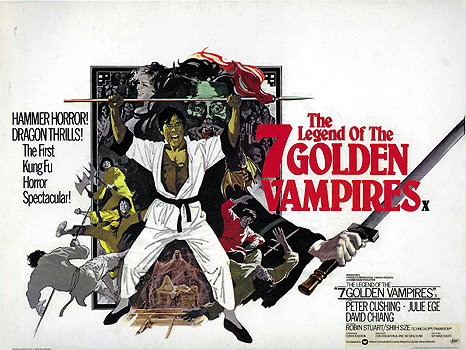
 The Legend of the 7 Golden Vampires / Dracula and the 7 Golden Vampires / 7 Brothers Meet Dracula / Qi Jin Shi (1974/1979) -***
After the self-inflicted wound of The Satanic Rites of Dracula, Hammer Film Productions at last grew desperate enough to try something truly new and exciting. Beginning in 1974, they entered into international co-production pacts with a trio of Asian movie studios: Shaw Brothers in Hong Kong, Toho in Japan, and Ramsay Brothers in India. Alas, only one of those projects ever bore fruit in a completed film. Nessie, the Toho collaboration, was somewhat unrealistic from jump, seeing as the Japanese firm was on its way out of the giant monster business at the time, while the British one had never gotten into it in the first place. The proposed Ramsay Brothers team-up had no such inherent obstacles in its way; indeed, there was a time not many years before when it might have looked like a can’t-lose proposition. But 1975 was not 1967, and Kali, Devil-Bride of Dracula was by then vulnerable to the argument that Dracula was no longer the hitmaker he used to be. That brings us to The Legend of the 7 Golden Vampires, the product of Hammer’s partnership with Shaw Brothers. Although the UK title obscures this, The Legend of the 7 Golden Vampires was Hammer’s ninth Dracula movie, and when it fizzled, even James Carreras was convinced to stop shoveling money into the count’s coffin. Thus was Kali left groomless at the altar the following year. The film has a toxic reputation among Hammerheads, not least because its script was the final straw for Christopher Lee, who refused to have anything to do with the project, and tried to talk Peter Cushing out of having anything to do with it, either. I’ll concede that it isn’t a good movie, and that it offers very little of what the dwindling Hammer fanbase was looking for besides. I’ll similarly concede that it also isn’t much of a Shaw Brothers film— although I’ve read that the Hong Kong cut is a little more satisfying from that point of view. But the two modes fuse here into a compound that isn’t found in nature, and I value that sort of uniqueness very highly nowadays.
The year is 1804; the place, the Transylvanian countryside. Not at all where you’d expect to find a Taoist priest, but Kah (Chan Shen, from Five Fingers of Death and Rivals of Kung Fu) has good reason— or more accurately, bad reason— to come here. Back home in Szechuan, Kah is the master of a cult devoted to the Seven Golden Vampires, a septet of undead brothers who once held the region surrounding the village of Ping Kwei in the grip of terror. Leading a cult dedicated to their appeasement made Kah a powerful man, but as the vampires were destroyed one by one in recent years, he and his followers found themselves on the outs. The wily old priest has heard tell, however, that Transylvania is home to a vampire even mightier than his former overlords. It is his hope that the infamous Count Dracula (John Forbes-Robertson, from The Vault of Horror and The Vampire Lovers) knows of infernal magic strong enough to restore the Seven Golden Vampires to unlife, so that he may regain his privileged position under them. Kah’s plan hits two snags, though, when he reaches the mausoleum beneath Castle Dracula to make his pitch. The first is that Dracula is a contrary bastard who doesn’t like to do favors for anyone, no matter how abjectly they beseech him. The other is that the count himself is in a bad way just now. He never says exactly what befell him, but the upshot is that he is now confined to his tomb. Now that Dracula thinks about it, however, maybe there’s an arrangement worth making here after all. If he had a new body, then whatever force is holding him to the crypt would lose its grip, and if Kah were dead, then Dracula could not merely resurrect him as a vampire, but install his own spirit within the risen corpse. At that point, why not go to Szechuan, and see what’s up with these Seven Golden Vampires? After all, Transylvania must have gotten pretty hot for Dracula to put him in his current fix, and a Chinese priest can’t exactly blend in around here, no matter whose spirit is animating him.
A hundred years later, at the University of Chungking, Professor Lawrence Van Helsing (Peter Cushing, who ultimately decided that a working holiday in Hong Kong was a great way to take his mind off of his dead wife) is auditioning as a guest lecturer before the regular faculty*. It isn’t going well. Van Helsing might have expected to score points by avowing his belief that the legend of the Seven Golden Vampires of Ping Kwei is not merely based on fact, but literally true. In fact, however, the lecture blows up in his face precisely when he does so, as the Chinese professors take him to task for treating them like a pack of superstitious bumpkins. In case the esteemed visitor from the Occident missed it, China had been a great civilization for over a thousand years already when the Britons were first getting the hang of plow agriculture, and Van Helsing can find some other dopes to listen to his fairy tales about vampires.
Lawrence consequently reckons that it’s his last night in Chungking when he and his son, Leyland (Robin Stewart, of Pacific Banana and Horror House) attend a party at the British consulate. Leyland isn’t thrilled about leaving, because he’s just made the acquaintance of a fascinating young Swedish lady by the name of Vanessa Buren (Julie Ege, from Creatures the World Forgot and The Amorous Milkman), and he was hoping to get to know her better before he and his father moved on. Not only is Vanessa gorgeous in that characteristic Scandinavian way, but she’s a dyed-in-the-wool adventuress with no fear whatsoever of impropriety or social opprobrium. Mind you, Leyland isn’t the only man in attendance at the consulate to take an interest in Miss Buren. She’s also caught the eye of Tong lord Leung Hong (Wan Han-Chen, of One-Legged Fiend and Chinatown Kid), who is accustomed to getting whatever he wants by any means necessary. Leyland has no idea what he’s getting himself into when he informs Leung that he has already made arrangements to escort Vanessa back to her lodgings after the party winds down.
In point of fact, both Van Helsings have some wild times ahead of them. Lawrence, upon returning to their rented villa, is greeted by a young Chinese man who introduces himself as Hsi Ching (David Chiang Da-Wei, from Five Shaolin Masters and The One-Armed Swordsman). If that name sounds familiar to the professor, it’s because Ching is a descendant of the very Hsi who is reputed to have destroyed the first of the Seven Golden Vampires over a century ago. He attended Van Helsing’s lecture at the university this afternoon, and was excited to hear him give credence to the old tales. Ping Kwei is Hsi’s home village, you see, and he can personally attest to the truth of what the professor said about the Seven Golden Vampires returning from their graves each year during the Seventh Moon to reassert their power over the living. It is Hsi’s hope that Van Helsing can be persuaded to undertake the journey to Ping Kwei, and to use his professed knowledge and experience of the undead to send the vampires back to the Underworld once and for all. Meanwhile, in a spectacular demonstration of good faith, Hsi’s six brothers— Kwei (Lau Kar-Wing, from Dirty Kung Fu and Shaolin Martial Arts), Do-Kwei (Huang Pei-Chih, of The Water Margin and Men from the Monastery), Ta (James Ma Chim-Si, from Fingers that Kill and The Ghost Lovers), Tao (Ho Kei-Cheong, from Delightful Forest and The Descendant of Wing Chun), and the twins, San (Tino Wong Cheung, of The Invincible Armor and Drunken Master) and Sung (Wynn Lau Chun-Fai, of The Shaolin Boxers and Dragon Fighter)— drop like an anvil of kung fu on the Tong ruffians sent to ambush Leyland and Vanessa by Leung Hong. When the elder Van Helsing learns what kind of muscle he’d have at his disposal (even the youngest Hsi, kid sister Mai-Kwei [Shih Szu, from Shaolin Temple and The Hooker and the Hustler], is a veritable dynamo of whoop-ass), and when Vanessa learns how much exciting trouble she could get into by financing the expedition, Ching’s proposal suddenly sounds altogether feasible. This is half a Shaw Brothers movie, though, so don’t expect the ensuing crusade against the Seven Golden Vampires to go off anywhere near as painlessly as it would in a pure Hammer production.
Roy Ward Baker, who directed the English-speaking cast in The Legend of the 7 Golden Vampires, certainly knew how to make a Hammer film, although his track record in that capacity is somewhat spotty. Nor could anyone possibly accuse Chang Cheh (who directed the Chinese cast) or Lau Kar Leung (who handled the action sequences) of not knowing how to make a Shaw Brothers film. Both the pitfall and the opportunity of this project was that nobody in the world knew how to make a Shaw Brothers-Hammer picture, or indeed had any concrete idea of what one ought to be in the first place. If you come away from The Legend of the 7 Golden Vampires thinking that they never did figure it out, I’m not going to argue with you very strenuously. Ultimately, I think Baker is more to blame for that than Chang, because by his own admission he didn’t understand kung fu movies, or see any value in trying to cross-fertilize them with gothic horror. Meanwhile, nothing that Baker had done for Hammer previously would have prepared him for the challenges he’d face here. Hammer’s horror films didn’t really have battles, nor did they require such a thing as an action director. Shaw Brothers had a whole ’nother way of doing business, and Baker was mostly content to sit back and leave everything to Chang and Lau whenever the fists started flying.
That contemptuous, hands-off attitude hurts The Legend of the 7 Golden Vampires, because it results both in stylistic discontinuities and in missed chances to do interesting things. Chang and Lau understood pacing very differently from their English co-director, and every time the movie changes hands, there’s a period of disorientation as it suddenly starts moving either much faster or much slower than it was a moment before. The foregone opportunities bother me more, though, in light of the promise held out by this particular combination of filmmaking personalities. For instance, notice that Leyland Van Helsing is a major player in defending Ping Kwei against the climactic all-out assault by the final three Golden Vampires and their horde of mindless jiangshi infantry. Mostly that means trying in vain to gun down the oncoming undead, but eventually he runs out of bullets and has to fight hand to hand. Imagine if, instead of trying gamely to suck at kung fu, Robin Stewart had studied up on Marquis of Queensbury boxing to position the character as a master of his culture’s fighting arts in parallel with the Hsi siblings. The Legend of the 7 Golden Vampires was playing East-meets-West on a dozen different fronts already; how cool would it have been to see the premise extended into the choreography of the action scenes as well? Even to think of such a thing would require some familiarity with the concepts of Asian martial arts cinema, however, which Baker didn’t have, and saw no reason to acquire.
I’m also inclined to fault Baker for not recognizing the necessity of dialogue dubbing for Julie Ege and David Chiang Da-Wei. The tentative romance between Leyland and Vanessa gets snuffed like a candle the moment the two Westerners meet Mai-Kwei and Ching respectively, with the result that Ege and Chiang become the principal love interest of the film. Unfortunately neither one of them spoke English with anything like the necessary proficiency. Chiang appears to have been mentally fluent, but found the pronunciation insuperably difficult. Ege had the opposite problem; her diction was perfect, but she plainly had only the faintest idea what she was actually saying as she recited her lines. Pair them up in a scene, and the combination of mush mouth and rigidity is a real workout for the viewer’s ears.
Then of course there’s the Dracula problem. This we can’t blame on either director, rooted as it is in years of contention between the studio leadership and Christopher Lee. Once Lee said no for the final time, the smart move would have been to write Dracula out of the picture altogether, making The Legend of the 7 Golden Vampires a solo outing for Van Helsing in the spirit of The Brides of Dracula. Keeping the count around anyway leads straight into the country of Damned If You Do and Damned If You Don’t. On the one hand, Dracula’s brief appearances at the beginning and end lead one to want more of him, even if only in the inadequate guise of the possessed Kah, because his presence as an ally of the Seven Golden Vampires creates a thematically compelling reflection of the alliance between the Hsi and Van Helsing families. But every time Chan Shen— or worse yet, John Forbes-Robertson— does show up onscreen, we become acutely conscious of how very much either man isn’t Christopher Lee. The most regrettable instance arises at the finale, when Dracula recognizes Van Helsing, assumes his true form once more, and is recognized by the professor in turn. Again, I can’t imagine what Baker could have done differently under the circumstances, but if you’ve seen any of the preceding eight series entries (let alone all of them), it’ll take you right out of the film: “Oh, come on! That guy isn’t Dracula!”
Just the same, though, there’s a lot to like in this movie if you give it a chance. The main thing in its favor, as I’ve hinted at a few times already, is how it keeps coming back to the idea of cross-cultural partnership and exchange. The film begins with Asian and European vampires joining forces, which provokes a team-up between Asian and European vampire-hunters, which leads in turn to a pair of interracial love affairs. The latter are surprisingly effective, too. Despite everything I said before about Chiang’s and Ege’s language problems, the pair have extraordinary interpersonal chemistry. Robin Stewart and Shih Szu don’t throw off sparks in the same way, but Leyland’s and Mai-Kwei’s attraction to each other is still more credible than most previous Hammer couplings, which far too often boiled down to “She has nice tits and no personality! He’s a rasher of white pudding that wished to be a real boy! Watch them gaze into each other’s eyes in dull surprise!” The character designs for the Chinese vampires are unexpected, and the scenes of them rising from their graves and riding into Ping Kwei on horseback have a commendable flavor of Tombs of the Blind Dead about them. And although the fight scenes are very much a B-game effort from Lau Kar Leung, Lau’s B-game was considerably better than many fight choreographers’ A-games. I can understand why no one knew what to make of The Legend of the 7 Golden Vampires back in the 70’s, but today’s aficionado of bizarre cinema should find it far more rewarding than its reputation would suggest.

Home Alphabetical Index Chronological Index Contact

*Yes, you’re quite right. Dracula, A.D. 1972 did indeed establish that Lawrence Van Helsing died 32 years earlier, in 1872. I have to assume either that he got better, or that he had amassed a fortune in whist debts with no practicable means of paying them off.