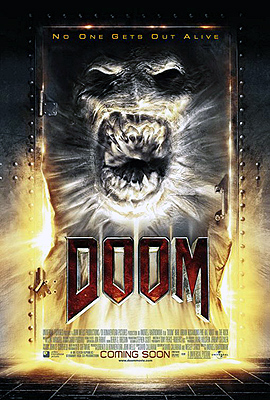
 Doom (2005) *½
The internet lied to me. I thought I was reviewing Doom as the 2026 entry for Movies Whose Times Have Come, because that’s just how dismally slim the pickings are for this year. In fact, though, 2026 turns out to be merely the inception date for the movie’s back-story; the action of the film is set fully 20 years later! But since I’m not about to wait until 2046 just to advise you not to bother watching a zero-effort Aliens clone that smells like the Rock’s dirty drawers, let’s all put clothespins on our noses, and dive in anyway.
What happened in 2026 was the discovery of an ancient super-science artifact in the depths of the Nevada desert— a teleportation machine set up to send stuff to a hitherto unexplored region on the surface of Mars. It’s much too old to have been built by any known human culture, and there was nothing at either site to indicate what purpose the teleportation link with Mars was supposed to have served. Archaeologists have been poking around at both ends of the space bridge ever since in search of answers, but are officially no closer to finding them even now. It’s a safe bet, however, that someone up there on the Red Planet has some ideas that they’re not quite ready to defend in public yet, because the location of the teleportation machine’s Martian end has been dubbed “Olduvai”— as in Olduvai Gorge, where the type specimen of Homo habilis, the earliest known member of the human genus, was discovered— while the contraption itself was given the Biblically suggestive name, “the Ark.” Nor is xenoarcheology the only scientific activity going on at Olduvai. The Union Aerospace Corporation, which underwrites the work there, is an avatar of the military-industrial complex, and its underground laboratory installation on Mars hosts all manner of cutting-edge research too sensitive to be conducted on Earth, from applied kaboominetics to Tampering in God’s Domain. Some of the latter, under the direction of one Dr. Carmack (Robert Russell, from Chained Heat 3: Hell Mountain and Snowpiercer) has just gone very badly awry. We don’t get to see what broke containment, but it’s very big, very deadly, and very difficult to stop.
Back on Earth, a space marine squad leader known by the call sign, Sarge (the aforementioned Dwayne “the Rock” Johnson, from The Mummy Returns and Hercules), gets bad news from his superiors. The leave for which he and his eight-man special ops team were scheduled has been cancelled. Instead of going home, Sarge and his men will be taking the Ark to Mars to clean up Dr. Carmack’s mess before it can spread beyond the genetics lab to endanger all 85 of the UAC employees living and working at Olduvai. Frankly, I’m not liking those people’s chances— and not just because I already know what kind of movie this is. In the manner of an nth-generation photocopy, two decades’ worth of compulsive repetition have stripped all nuance from the arrogantly unready but well-intentioned and ultimately competent space marines of Aliens, leaving Sarge in command of a coterie of fuckups, loose cannons, cowards, and psychos.
Mac (Yao Chin) is the only one of the bunch whom I’d fully trust to have my back in any truly hairy situation— which means that the joke’s on me, because Mac is also the only member of the squad to get taken out by Carmack’s escaped monsters without firing a shot. The Kid (Al Weaver) is panic-prone, wet behind the ears, and addicted to some manner of mood-stabilizing pills. Goat (Ben Daniels, from Rogue One and Jack the Giant Slayer) carves crosses into his flesh as penance whenever he takes the Lord’s name in vain. Duke (Razaar Adoti, of Resident Evil: Apocalypse and The Summoning) and Destroyer (Deobia Oparei, from Dark City and Alien3) both project that form of exaggerated hard-ass swagger that invariably functions as artificial buttressing for a personality broken at its core. Portman (Richard Brake, of Death Machine and Halloween II) is such a baroquely twisted fuck that it’s hard to believe they didn’t cast Brad Dourif or Bill Moseley to play him. And although Reaper (Karl Urban, from The Truth About Demons and Dredd) seems like a standup guy, he has some connection to Olduvai ten years in his past so compromising that Sarge encourages him to sit out the mission.
Actually, let’s clear up that mystery before we go any further. Reaper has rather an odd background for a space marine, insofar as he spent his youth training to be a breed of scientist that the real world hasn’t yet developed any need for— something like a molecular xenoanthropologist, maybe? His parents were part of the team that began the archaeological excavations at Olduvai, and his sister, Dr. Samantha Grimm (Rosamund Pike, from Surrogates and The World’s End), is up there right now carrying on the family business. Mom and Dad, on the other hand, are not, because they were both killed in some kind of accident during their excavations. Each sibling regards the other’s career choices in the decade since as dishonoring their parents’ memory, so expect lots of friction once Reaper arrives on Mars.
The members of each UAC research department at Olduvai all swear that their work is completely unconnected to that of every other— and I suspect they all genuinely believe that, too. But what that should tell us is that UAC is exactly as trustworthy an employer as Weyland-Yutani, for in fact the genetics lab, the armaments program, and the archaeological dig are intimately interlinked. It all comes back to the remarkably human-like fossil skeleton of a long-dead Martian woman, which Grimm and her team have dubbed (what else?) “Lucy.” It’s impossible to look at Lucy without concluding that her people and ours are related somehow, but genetic analysis of her skeleton reveals something even more extraordinary. Lucy’s race had an extra pair of chromosomes, and there’s every indication that their chromosome 24 is synthetic. Sam doesn’t know this, but Carmack’s lab was charged with recreating chromosome 24 for experimental incorporation into the human genome. The UAC bosses were hoping for super-soldiers, but what they got were infectious zombies that slowly transform into even worse things kinda-sorta resembling various low-to-mid-status monsters from the Doom video games. And although those monsters are confined for the moment to the ruins of Carmack’s genetics lab, the space marines’ own inept extermination efforts are about to make them everybody’s problem.
Here’s what a big damn deal Doom was in 1993, when the original game was first released. I knew that it was the hottest computer game on the market, even though I hadn’t owned a computer powerful enough to play games of any sophistication since 64 kilobytes of RAM was the state of the art! Five years later, in 1998, it was estimated that more computers had some version of Doom installed than were running the latest iteration of Windows. You might therefore expect the makers of a Doom movie to trust in the games’ popularity, hewing as closely as possible to the source material’s subject matter, however much the change of medium might dictate alterations in story structure or characterization. And even if gamers weren’t a big enough target audience for a movie studio’s comfort in 2005, you cannot convince me that fans of sci-fi action flicks wouldn’t have drooled like Pavlov’s dogs over the prospect of a film about teleportation experiments on Mars opening the door to a literal Hell inhabited by demonic cyborgs. That isn’t what Universal gave us, however. No, they just reheated James Cameron’s decades-old leftovers yet again, spicing the mix with some of the newly fashionable running zombies. It’s right up there with turning Double Dragon into Kidz Bop RoboCop, but not nearly as charmingly quirky. Also, because the source game was a first-person shooter (arguably the first-person shooter), director Andrzej Bartkowiak felt compelled to wedge in an extended sequence of first-person shooting. It’s as ridiculous here as it was in House of the Dead two years earlier, and it accomplishes nothing but to distinguish Bartkowiak as the only director in history ever to rip off Uwe Boll.
The closest Doom ever comes to developing a personality more individual than “Aliens, but stupid” is when it attempts to sneak some crackhead metaphysics in through the back door. In what might be a final, withered vestige of the game’s “space invaders from Hell” premise, it turns out that chromosome 24’s effects have a moral component. Those who incline toward evil become degenerating zombies, while those who incline toward good become supermen. Or at least that’s the theory. In practice, the need to funnel the movie into that first-person monster-killing spree requires that only a single character ever get the Übermensch upgrade. It is, to say the least, very difficult to construct definitions for good and evil which put that guy on one side of the line and everyone else who ever gets exposed to chromosome 24 on the other. What’s truly surprising, though— and would indeed be thought-provoking, if I believed there were any conscious intent behind it— is that Sarge doesn’t get the superhero origin story. In fact, he ends the film as the closest thing it has to a video game final boss. Mind you, that doesn’t mean Sarge transforms into an analogue for any of the Doom games’ boss monsters; even in 2005, the Rock was too vain to accept closing out a movie as the motion-capture model for a bio-mechanical brain-spider with a Gatling gun where its chelicerae ought to be. Still, a more thoughtful filmmaker could have done something nervy by turning such an obvious action hero villainous at the last, especially in an era when the rest of mainstream pop culture was all-in on the idea that atrocities aren’t atrocious when our guys commit them. Ultimately, though, Doom is just out for an excuse to have a couple of jacked dudes pummel each other in the dark while trading lame badass one-liners.
Doom’s most critical failure, however, is that it manages to disappoint even by the lenient standards of the Big, Dumb Action Movie. Universal reportedly spent $60 million making Doom, but I cannot for the life of me tell you where it went. Seriously, watch this film in conjunction with something like Galaxy of Terror or Forbidden World, and be amazed at the pathetic lack of spectacle outside of the opening CGI zoom-in from roughly the orbit of Phobos to the exterior of the Olduvai complex. Most of the monster fights are too under-lit to generate any visual interest, and the creature suits are as devoid of personality as any I’ve seen. Meanwhile, although Doom belongs to the final phase of the period in which Hollywood movies got bragging rights for hiring a Hong Kong guy to oversee the action sequences, the producers might as well not have bothered. It isn’t that Dion Lam does a bad job so much as that the cinematography and editing make it impossible to tell one way or the other. There’s just no excuse for a man-on-monster duel in which one of the combatants wields a cathode-ray-tube computer monitor as a flail to be so limp and baggy. And although this is a little thing, it’s surprisingly detrimental to the film that so many of the gunfights put the muzzles of the weapons outside the frame at trigger-pulling time. One needn’t have any emotional investment in the games whatsoever to be annoyed at the perfunctory piece of shit adapted from them here.

Home Alphabetical Index Chronological Index Contact
