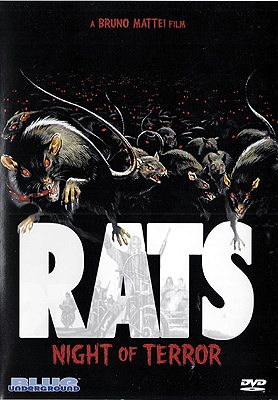
 Rats: Night of Terror / Rats of Manhattan / Blood Kill / Rats: Notte di Terrore (1984) -***
In the Christian Year 2015, the insensitivity of man finally triumphs, and hundreds of atomic bombs devastate all five continents. Terrified by the slaughter and destruction, the few survivors of the disaster seek refuge under the ground. From that moment begins the era that will come to be called After the Bomb, the period of the second human race. A century later, several men, dissatisfied with the system imposed on them by the new humanity, choose to revolt and return to live on the surface of the Earth as their ancestors did. So yet another race begins, that of the New Primitives. The two communities have no contact for a long period. The people still living below the ground are sophisticated. They despise the Primitives, and regard them as savages. This story begins on the surface of the Earth, in the year 225 A.B.— After the Bomb… |
That is not at all how I was expecting Rats: Night of Terror to start. Understand that this is indeed the swarm-of-vermin horror flick that the title and the promotional art would imply. It’s just that it’s also a post-apocalypse movie in roughly the vein of A Boy and His Dog, positing an After the End scenario more complex than the usual 1980’s routine of motorized barbarians with punk esthetics waging Hobbes’s war of all against all for control of some dwindling resource. I’ve never seen that particular genre mashup before, and I bet you haven’t either. Before you get too excited about Rats: Night of Terror, however, be advised that it was written by Claudio Fragasso, and directed by Bruno Mattei. Those two are an acquired cinematic taste if ever there was one, and like most of their works, Rats is defiantly junky, proudly nonsensical, and occasionally so far up its own ass that even the Voyager probes would have a hard time receiving signals from it. Also, Rats: Night of Terror builds to a feat of sheer dumbth that you’ll never forget once you see it.
If Rats begins on the surface of the Earth, it follows that it also begins among those New Primitives, right? There are eleven such nomads with whom we need concern ourselves, roaming the nuke-scarred world in a hodgepodge of reconditioned pre-apocalyptic motor vehicles ranging from bikes to an armored personnel carrier. The leader is named Kurt (Escape from Galaxy 3’s Ottaviano Dell’acqua, whose most attention-getting role was probably that of the wormy ghoul who rises from the old Spanish cemetery in Zombie). That’s pretty much his whole personality, which puts him about on par with his followers in terms of characterization. Diana (Cindy Leadbetter, from Monster Hunter and The Adventures of Hercules) is Kurt’s mate. Duke (Malombra’s Henry Luciani) is Starscream to Kurt’s Megatron, ever on the lookout for opportunities to undermine his authority or to usurp his position. The guy with the curly, blond hair is Video (Gianni Franco, of Atlantis Interceptors and Delirium), so called because of his claimed affinity for the old world’s electronic devices. Lilith (Moune Duvivier) is witchy and horny, while her lover, Lucifer (The Sweet House of Horror’s Jean-Christophe Bretigniere), is horny and crass. Noah (Dangerous Women’s Christian Fremont) is the smart one. Deus (Fausto Lombardi, from Don’t Look in the Attic and Terror Express) is the mystic, well read by post-apocalyptic standards in literature from Before the Bomb. Myrna (Ann Gisel-Glass, of Hanna D.: The Girl from Vondel Park) flies into hysterics at the slightest provocation. Chocolate (Geretta Giancarlo, from Bloody Christmas and Smithereens) is black, which Mattei and Fragasso think is a personality trait in and of itself. But even she comes out better than poor Taurus (Massimo Vanni, of Emanuelle and Françoise and After Death), who has no memorable characteristics at all besides a beard that makes him resemble a poor man’s George Eastman.
Anyway, the group’s travels carry them to the ruins of a city, where they are thrilled to discover a massive cache of still-edible foodstuffs in categories that are almost never found up on the surface anymore. They also discover a sophisticated computer setup, which Video fruitlessly tries to get working, and a hydroponic garden complete with its own water purification system. What they don’t find is any trace whatsoever of the people who might have retrofitted the ruins with those amenities, which all seem to be beyond the present technological capacity of any New Primitive group. Then when Video finally does get something out of the computer more or less accidentally, it’s just one enigmatic but ominous line of text: “TOTAL ELIMINATION GROUP.”
Just the same, the city represents a major opportunity for Kurt’s people, since there’s nothing else like it in the surrounding wasteland in terms of shelter and provisions. They might as well take advantage of it unless and until some concrete reason to move on presents itself. Those of you who read the movie’s title (unless you’re in Germany, watching it as Blood Kill) will already have some idea of what form that reason for moving on will ultimately take, but we’re not talking about just any old bunch of rodents here. No, these are post-atomic mutant rats, bred in the depths of the world below. They’ve grown not merely vicious, but intelligent and organized as well. Indeed, they’re so smart and so well coordinated that they can treat even humans as prey animals. And since all the major urban rat species are apparently extinct on the surface in 215 A.B., the New Primitives are wholly unequipped to deal with such a threat.
Bruno Mattei always considered Rats: Night of Terror to be sort of a belated sister production to Night of the Zombies. That seems odd at first, since the two movies have different settings, different premises, different sets of subgenre associations, and no more commonality of cast or crew than any other pair of films in the director’s catalog. Look just a little closer, though, and it starts to make sense. Both films are siege stories at heart, in which preexisting divisions among the besieged are ultimately at least as deadly as the besieging monsters. Both have as their protagonists a group of people accustomed to thinking of themselves as major badasses, who get into trouble by going someplace they don’t understand, and by underestimating an enemy with which they’re totally unfamiliar. Both movies posture unconvincingly, when they remember to do so, as allegories of low-tech societies being preyed upon by high-tech ones— although Rats handles that aspect in such a confused and confusing manner that it’s barely worth talking about, and certainly not worth taking seriously. And Night of the Zombies and Rats: Night of Terror alike have twist endings revolving around the kind of pseudo-profound ideas that come to you at 4:00 AM when you’re seventeen years old and righteously stoned. That last point is the Fragasso signature, and Rats bears it as boldly and garishly as any movie that loony ever wrote. Credit where credit is due, though: as ridiculous as this picture’s ending might be, it isn’t quite the bolt from the blue that it would sound like if I simply told you what happens. Although you probably need some familiarity with Fragasso’s style to recognize them as such, the whole film is stocked with subtle hints as to where it’s going— enough, anyway, that I found myself thinking, “Hang on— they can’t possibly be about to…” roughly five minutes before the final revelation.
All that said, a significant point of interest in Rats: Night of Terror is how it shows that there somehow exists such a thing as a minor entry in the Mattei-Fragasso oeuvre. This film is visibly cheap even by their usual standards, as you’ll first observe when the New Primitives’ APC cranks into action during the opening credits, and it becomes evident from its movements, shape, and proportions that there’s the stripped-down chassis of a Volkswagen Microbus somewhere underneath all that wobbly sheet-metal “armor.” Geretta Giancarlo, incredibly, is the most recognizable face in the cast— and this was two years before her kinda-sorta star turn as the undead prostitute in Demons! The sets are all recycled from earlier, better-funded films, including most notably the several blocks of fake New York built at Cinecitta for Once Upon a Time in America. (I suspect that the French distributors were trying to get out ahead of those streets’ familiarity for European audiences by re-titling the movie Rats of Manhattan.) The gore scenes are gloriously shoddy, especially because so many of them are far more ambitious than the resources at Mattei’s command could adequately support.
But by far the most charming of the cut corners in Rats: Night of Terror concern the rodents themselves. Naturally this film required a lot of rats, and just as naturally, Mattei would have preferred them to be Rattus rattus, the black rat of bubonic plague fame. The trouble was, he found it impossible to hire enough black rats to get the job done— nor indeed could he acquire a sufficient stock of the bigger but less sinister-looking Norway rats that infest most of the Northern Hemisphere’s major cities. In the end, Mattei settled for buying job lots of white laboratory/feeder rats, and dyeing them black! Understandably, the production assistants whose task that was were none too meticulous about it, but even the most carefully blackened of the rats reveal their true nature via their vividly pink eyes, which no wild rodent ought to have. Also, it should go without saying that Rats: Night of Terror employed no animal trainer as such. These are therefore some of the least purposeful-seeming death-swarms to be found in any horror movie, conspicuously more interested in cleaning the stinky hair dye residue from their fur than in enacting Mother Nature’s Revenge. Note, too, these rats’ curious habit of ambushing their human prey by dropping en masse from convenient gaps in the ceiling. What better way to motivate hordes of untrained python-chow rodents to “attack” than by dumping them on the actors by the literal bucketful from somewhere above the frame? There may not be a single performance in Rats: Night of Terror that’s anything short of risible, but I surely can’t accuse this cast of not earning their pay!

Home Alphabetical Index Chronological Index Contact
