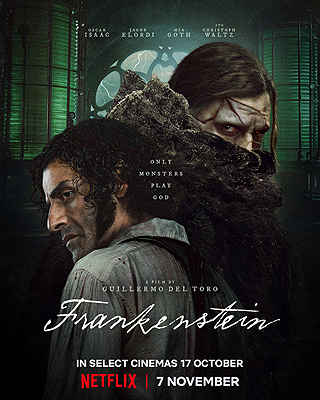
 Frankenstein (2025) ***
I haven’t followed his career closely enough to pinpoint when exactly I think this happened, but unmistakably there came a day when Tim Burton ceased just making movies with a distinctly personal style and sensibility, and began making Tim Burton Moviestm instead. Nor is Burton alone in reaching such a turning point. Indeed, I’d argue that descending into self-consciousness that flirts with self-parody is a risk run by any artist of whom it can fairly be said that nobody else does it like they do. Alas, I fear that Guillermo del Toro is standing at that threshold now. Although his version of Frankenstein is in many respects awfully good, it feels as much like an assemblage of tics and hobby horses as it does like a coherent artistic vision. For all its interesting divergences from most earlier interpretations of the story, it contains very little that’s truly original with respect to del Toro’s own career to date. With thematically apt irony, most of Frankenstein could have been stitched together from pieces of Pinocchio, Cronos, Crimson Peak, and The Shape of Water.
The year is 1857 (nearly four decades after Mary Shelley’s Frankenstein, or The Modern Prometheus was first published, and indeed two decades later than the now-standard revised version of the novel), and a Swedish sea captain by the name of Anderson (Lars Mikkelsen, from an altogether different Island of Lost Souls than the one you thought of when I said that) is caught up in the international race to reach the North Pole. So far, his main accomplishment has been to get his ship stuck in the sea ice, and his sailors are losing confidence in both him and their mission. One night (the fact that we can still speak of days and nights shows how far Anderson is from his goal), the lookout spots what appears to be a bonfire about two miles away off the port bow, which suddenly erupts into an explosion. Anderson sends a team to investigate, and thus does he wind up playing host in his cabin to a badly banged-up man with a rather sophisticated prosthetic leg (Oscar Isaac, from Star Wars: The Last Jedi and Dune, Part One). There’s no time to deal with him just now, though, because no sooner have his most immediate needs been seen to than the ship comes under attack by a hulking, man-like creature (The Mortuary Collection’s Jacob Elordi) that shrugs off even the most powerful bullets, and possess the strength to rock Anderson’s 2000-ton vessel on its keel. Only by breaking up the ice directly beneath the thing’s feet with gunfire, and sinking it into the frigid ocean below, can Anderson’s men thwart its assault. By that point, the commotion has stirred the captain’s injured guest back to consciousness, and he warns that Anderson and his crew haven’t seen the last of the monster-man even now, incredible though that sounds. Don’t worry— the man from the ice will explain everything, but first permit him to introduce himself. His name is Victor Frankenstein, and what qualifies him to speak with authority about the creature that attacked the ship is that he made the wretched thing.
Victor is the son of Baron Leopold Frankenstein (Charles Dance, from Alien3 and The First Omen) and an even wealthier noblewoman named Claire (Mia Goth, of Infinity Pool and X). Leopold was perhaps the greatest doctor in all Switzerland in his day, and he was hell-bent on raising his son to succeed him in his profession as well as his title. Victor’s upbringing was therefore stern to the point of cruelty, and only when his father was away on business (which happened rather often, to be sure) did the boy ever experience any sort of parental affection. It was consequently doubly traumatic when Claire died while giving complicated birth to Victor’s brother, William (eventually to be played by Felix Kammerer), despite his father’s best efforts to save her. Worse yet, as soon as William was out of the womb, old Leopold started doting on him like an indulgent grandpa, while subjecting Victor to even greater mistreatment than before. Claire’s death was transformative for Victor in another way, too. It awakened in him a determination not merely to match his father’s skill as a healer, but to eclipse it. One day, or so the boy vowed, he would do what Leopold could not, and conquer death itself!
If you’ve ever seen a Frankenstein movie before, you already know roughly what that means. Acrimonious confrontation with the faculty at Victor’s medical school. Withdrawal to a secret laboratory converted at great expense from some ancient tower in the middle of nowhere. Corpse-parts acquired in job lots from every possible source of such things, from morgues to gallows to the battlefields of the Crimean War. Gigantic galvanic contraption harnessing the power of lightning to bring the creature assembled from those parts to life. This version does add some noteworthy new wrinkles, however. Leopold Frankenstein wasn’t half as good at business as he was at surgery, so by the time Victor was making a scandal at the University of Edinburgh, the family had fallen into a state of genteel cash-poverty. Frankenstein therefore needed an angel investor for his work, which he found in the form of Heinrich Harlander (Christof Waltz, from Alita: Battle Angel and Django Unchained), an arms manufacturer with a wide-ranging fascination for scientific and technological novelties of all kinds. It was Harlander who drew Frankenstein’s attention to new research into the lymphatic system, which seemed to promise an effective method for distributing the life-giving electrical current throughout the constructed body. Heinrich also used his political connections to smooth the way for Frankenstein’s harvesting of the raw materials necessary for construction. And of course he spent lavishly to equip Victor’s lab with everything required for his experiments. One might therefore ask what Harlander was to receive in return. Well, as I said, Heinrich was a devotee of technological and scientific novelties, and his great recreational passion at the time was for the newly perfected art of photography. The first thing he wanted from Frankenstein was the opportunity to make a comprehensive photographic record of his work. And as for the second thing, Heinrich told Victor to expect him to ask for a favor one of these days, but left it at that until long after their partnership was sealed.
Another unexpected thing that del Toro brings to Frankenstein is a thoroughly revised concept of the relationship between Victor and Elizabeth. Del Toro’s Elizabeth is the strong-willed and eccentric niece of Heinrich Harlander, and she enters the story not as Victor’s fiancée, but as William’s. As Frankenstein confesses to Anderson, however, no sooner did he meet Elizabeth than he fell in consuming, obsessive love with her, and he embarked at once upon an underhanded campaign to win her away from his brother. (Frankenstein’s pursuit of Elizabeth is made extra-shady, too, by the fact she’s a dead ringer for his mom, being played as well by Mia Goth.) Although Elizabeth humored Victor’s attentions for a while, the truth is that she never considered him more than an amusing cad. No, the only man who might have stood a chance of coming between her and William was the one Frankenstein was building— but let’s not get ahead of ourselves.
Ever since 1931, it’s been traditional for Frankenstein’s man-making to go awry over the matter of the brain. Maybe he picks the wrong one. Maybe it gets damaged before installation. Maybe there’s contention about which brain should be used in the first place. But it’s almost always the brain that throws the fatal monkey wrench into the works. This Frankenstein falls into category three, as del Toro takes a cue from The Ghost of Frankenstein, of all sources. That deferred favor that Harlander mentioned? He wanted Frankenstein to use his brain. Heinrich was suffering from syphilis, which in the 1850’s was almost as terrifyingly deadly as AIDS in the 1980’s, and Victor’s work seemed to offer an escape from his polluted body before the ruinous tertiary symptoms set in. No way was Victor going to give his creature a poxy brain, however— and although he won that argument, he did so only at the cost of Harlander’s accidental death (but how accidental was it really?) in a fall down the lab tower’s central shaft. So while the creature sprang to life unimpeded by the usual defective brain, it was born under a cloud of opprobrium just the same, because Victor later told William that it killed Heinrich rather than acknowledge his own role in the fatal mishap. Nor was the synthetic man in any position to say otherwise, because the only word it had mastered by the time William and Elizabeth visited the lab to look in on Victor and Heinrich was its creator’s name.
Okay— now we’re justified in taking up the subject of Elizabeth’s relationship with Frankenstein’s creation. Not long after arriving at the laboratory tower, Elizabeth was drawn down to the basement by the sound of an inarticulate but piteous groaning. It was the creature, of course, which Frankenstein had started keeping in chains down there on the theory that it was functionally ineducable, and doomed to spend its entire life with the mind of an infant. Elizabeth knew nothing of her future brother-in-law’s work, but she did know that he was an egotistical asshole with the ethics of a bedbug. Her immediate assumption was therefore that the huge, gangling, horrifically scarred man shackled to a stone plinth in the underground vault was the victim of some obscene vivisection experiment. Even after learning the truth (or as much of it as Victor saw fit to tell, anyway), Elizabeth took a very different attitude toward the man-made man than either of the Frankenstein brothers. She found him by turns tragic and noble, even daring to speculate that the method of his creation might exempt him from the effects of Original Sin. Indeed, the look in Elizabeth’s eyes whenever she and the creature were together would have been enough to tell any observer that she was downright attracted to him.
That was entirely too much for Frankenstein. No sooner did William and Elizabeth depart for home than Victor stormed down to the vault to confront his “failed” creation, to search for even the faintest sign of the positive qualities that Elizabeth so unaccountably saw in it. Never for one second did he consider the possibility that the creature behaved differently around her precisely because she never treated him as an “it.” The irony was that the creature really did give Victor what he wanted— but in a form guaranteed to embitter him against it even further. When Frankenstein demanded that it demonstrate its capacity for learning by saying anything at all besides “Victor,” it eventually replied, “Elizabeth.” That was when Frankenstein set his lab on fire, determined to eradicate every last trace of his life-making project, which he had come to see since its culmination as a descent into madness. Obviously the conflagration failed to destroy the creature, however, or Frankenstein wouldn’t be in his current predicament. But if we (or Anderson) want to hear that part of the story, perhaps we should get it from the creature’s own recycled lips instead. He’s just returned to the ship and fought his way through Anderson’s men, so it really shouldn’t be any trouble to ask…
Way back in 1956, when Hammer Film Productions embarked on the project that became The Curse of Frankenstein, studio co-boss Will Hinds instructed screenwriter Jimmy Sangster to differentiate his script from all the previous stage and screen adaptations by making Victor Frankenstein “a shit.” Guillermo del Toro did much the same in this Frankenstein, but in a crucially different way. Sangster’s Frankenstein is a Miltonian figure, towering and charismatic in his unrepentant evil, driven by grand visions which he pursues with a commitment that would be admirable if it were in any way leavened by conscience or compassion. Del Toro’s Frankenstein has grand visions, too, of course, but they’re all rooted in some unmet childish need, petty and personal to the point of sordidness. He is a weak man, as selfish and petulant as he is callous and unprincipled— and yet del Toro refuses to let him be purely and simply the villain of the piece, playing up wherever possible some potentially mitigating circumstance of his background. That’s because del Toro, like Mary Shelley herself, is employing this story at least partly as an allegory of inept and inadequate parenting, drawing upon his troubled relationship with his own father. But del Toro is after reconciliation, not exorcism, and it’s therefore necessary to him that Victor, for all his faults, remain redeemable, or at least forgivable. I’m not sure he actually achieved that aim, mind you. Frankenstein in this picture is such a prick, in so many ways— and Oscar Isaac is so brilliantly, persuasively prickish in all of them— that I find it hard to muster the sympathy for him that del Toro seeks. But that’s also a problem I have with the source novel, so one can argue that the film holds true to its inspiration there.
Fidelity to the source ends up being a fraught issue in Frankenstein, and gets fraughter the closer you look at the film. Del Toro has maintained a virtually lifelong love affair with the book, so he naturally felt some self-imposed pressure to do right by it. The trouble is that he’s maintained even longer love affairs with some previous screen adaptations that weren’t book-faithful at all, and he wanted to do right by those, too. Then of course he had ideas of his own about the story and its potential meanings, which are at best in tension with both sets of influences, and are often flatly incompatible with either. A genuine synthesis of everything del Toro wanted to pull together here was almost certainly possible— indeed, a genuine synthesis of most of it already exists, in the form of Frankenstein: The True Story— but he simply couldn’t bring himself to make the hard choices required.
I’ve already pointed out how the director’s auto-psychotherapeutic aims are at odds with his and Oscar Isaac’s actual characterization of Victor, but the interpretation of the creature put forward here is even more problematic. Granted, Frankenstein, or The Modern Prometheus is pretty much the original misunderstood monster tale. Even in Shelley’s telling, however, a crucial part of the point was that the monster ultimately earns that epithet. Nobody had yet heard of the cycle of abuse in 1818, but neither did they need psychoanalytic jargon to tell them that callous, neglectful parents have maladjusted, dangerous children. Guillermo del Toro doesn’t just love monsters, though. He identifies with them— and Frankenstein’s synthetic man is the monster with which he identifies most of all. It isn’t enough for del Toro, then, that the creature be sympathetic. It isn’t enough for the monster to be strangely beautiful despite the scars and the cyanotic skin, or for the one woman in the film who actually meets him to get damp in the drawers for him in a way that even her fiancé can’t provoke. Del Toro indeed goes to the furthest extreme of wish-fulfillment fantasy, turning the movie into a cleverly disguised superhero origin story! Note that there’s nothing inherently wrong with that, if that’s the kind of Frankenstein del Toro wanted to make. Honestly, I rather wish he had made it, since “I, Frankenstein, only visually stunning and suffused with Mexican melancholy” sounds pretty fucking intriguing. But that isn’t Mary Shelley’s Frankenstein, nor is it James Whale’s or Terrence Fisher’s, and every adoring genuflection toward those antecedents emphasizes the fact while detracting from the uniquely personal thing that del Toro’s Frankenstein could have been instead.
Beyond all that, the simple fact is that del Toro has been mining Frankenstein’s themes and concepts for so long in his other projects that there’s really not much left for a direct adaptation to do. Meanwhile, the aesthetics of Frankenstein are wearyingly recursive toward the director’s previous work. Frankenstein’s laboratory is a dead ringer for Crimson Peak’s Allerdale Hall. Jacob Elordi’s creature is basically a prettified composite of every monster suit ever donned by Doug Jones at del Toro’s behest. The angel that haunts Victor’s dreams could have come out of Hellboy via a detour through Pan’s Labyrinth. And speaking of Pan’s Labyrinth, Leopold Frankenstein is a lot like a less despicable Captain Vidal, while Victor’s relationship with his mother (and with his mother’s memory) is a perverted reflection of Ofelia’s with her endangered mom. Elizabeth is half Edith Cushing and half Elisa Esposito, a strong-willed female oddball who sometimes fantasizes about riding monster-dick. Even Heinrich Harlander has obvious antecedents in Cronos’s scheming rich bastards, Dieter and Angel de la Guardia. The ultimate passion project from an artist of Guillermo del Toro’s ability has no excuse for feeling this goddamned familiar.
But while Frankenstein never equals the sum of its parts, I can’t deny that most of those parts, taken in isolation, are phenomenal. For starters, it offers the perfect interpretation of the title character for an age when one load-bearing structure of society after another is “disrupted” into oblivion by privileged shitheads with bleeding wounds in their souls, who then congratulate themselves as world-historic geniuses for their wrecking. That veiled critique of Silicon Valley techno-messianism is tangential to del Toro’s principal aim, but the material is rich enough for him to have built the entire film around it, had he wanted to. Jacob Elordi’s rendition of the monster is less extraordinary, having much in common with both Bo Svenson’s and David Warner’s, but it fully deserves to stand in that company. Elordi’s physical acting is especially praiseworthy, vividly conveying a being with the capacity for tremendous grace and agility, but which is still learning how to control its enormous, unwieldy body. (There may be some autobiography in that aspect of the performance. I can well imagine a teenage growth spurt that doesn’t let up until you hit 6’5” leaving memories sharp enough for an actor to use even 20 years later.) The specifics are nothing alike, of course, but the best point of comparison I can think of for the amount of thought and attention that Elordi obviously devoted to his movement and bearing is Peter Weller in the original RoboCop. Mia Goth is striking and memorable in the underwritten and not entirely coherent part of Elizabeth, but she truly shines as the doomed Claire Frankenstein. The smartest and most effective thing about Frankenstein, though, is del Toro’s decision to treat Victor and the creature as equal co-protagonists. Indeed, I wish he’d gone ever further in that direction. This movie would have benefited from a little more Rashomon, juxtaposing the two characters’ conflicting views of the same events rather than just handing over narrative control at a fixed point in time. All in all, I did like Frankenstein. The problem is that I wanted to love it, and that a version of the film that I would have loved seems so clearly to have been within del Toro’s power.
Home Alphabetical Index Chronological Index Contact
