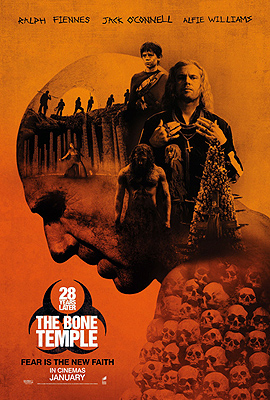
 28 Years Later: The Bone Temple (2026) ***½
At the end of 28 Years Later, Spike, the movie’s juvenile protagonist (Alfie Williams), felt sufficiently changed and unsettled by his experiences on the British mainland that he could no longer return to his old life on tiny Holy Island, at least for the time being. Inevitably, however, he quickly got into more trouble with the infected than he could handle by himself, and it looked for a while like the kid wouldn’t live long enough to sort through his turmoil. But then at the last moment, Spike was offered rescue by a group of oddly attired teenagers led by a 30-something man (Jack O’Connell) whom we last saw at the beginning of the rage virus outbreak, when he was but a child himself. The teens mopped the floor with the infected as soon as they got Spike’s assent to intervene, and the closing credits slammed down like a portcullis of utter bewilderment. Who the fuck were those kids? Why were they all wearing track suits and blond wigs? And why were they all named Jimmy? What in all nine of the Hells was going on here?!
British viewers would have been a tad less baffled than their American counterparts, because they at least would have recognized the reference implicit in the track suits, the wigs, and the name shared by Spike’s rescuers: the zombie-slaughtering kids were all done up as Jimmy Savile. Savile was a persistent and contradictory figure of British pop culture in the second half of the 20th century, and a little ways into the 21st. He emerged in the late 1950’s as a radio DJ, then expanded into television in the early 60’s, hosting a variety of youth-oriented music programs in both media. Perhaps most famously, he had a remarkable 20-year run as a presenter on “Top of the Pops” starting in 1964, and returned to close out the show’s final broadcast in 2006. And as befit a figure associated with rapidly mutating youth culture, Savile assiduously cultivated an eccentric image, dressing oddly, frequently changing his hair color, and peppering his speech with oft-repeated catchphrases. At the same time, he also became famous for his philanthropy, raising immense amounts of money for hospitals all over the UK and lending the power of his fame to a variety of other charity efforts. Then there was “Jim’ll Fix It,” a TV show that worked sort of like a less depressing version of the Make a Wish Foundation, in which viewers (most of them children) wrote in with their most heartfelt wishes, and Savile pulled whatever strings were necessary to make them come true.
But Jimmy Savile also had a dark side, for he was a sex pest on a level commensurate with the more visible aspects of his over-the-top career. Everywhere he went— most emphatically including the set of “Jim’ll Fix It” and those hospitals for which he panhandled so adroitly— rumors of women groped and children molested invariably followed. Savile was protected throughout his life, however, by his status as a beloved celebrity weirdo, by his reputation as a national-scale do-gooder, and by the extremely plaintiff-friendly defamation laws of the United Kingdom. Only after his death in 2011 did the story of Savile’s double life as a rapist and a kiddie-fiddler break containment. Remember, though: 28 [Intervals] Later posits that Britain was undone by zombie apocalypse in the early aughts. In this timeline, Jimmy Savile probably succumbed to the rage virus, by which point anyone who might have been inclined to investigate the funk of sexual misconduct clinging to him would have had bigger things to worry about. The implications that follow from there are the most British thing about these extremely British films, and bear reexamining periodically throughout 28 Years Later: The Bone Temple as new information about the kids in the track suits comes to light.
In any case, it turns out that Spike might have thought twice about accepting the Jimmies’ help had he understood what the price was going to be later. They’re not just a gang, you see, but a full-on cult. Their adult leader— Lord Sir Jimmy Crystal, he calls himself— purports to be the favorite begotten son of Satan, commanded by his father to spread the charity of death by torture to all those unfortunates who have thus far escaped the clutches of His demons. Note that this is neither some obscene grift nor a mere patina of showmanship applied to a psychopathic rampage. Lord Sir Jimmy genuinely believes this stuff, and his followers (all of them too young to have ever known a Britain not totally cut off from the outside world and swarming with contagious zombies) believe it, too. Spike is in something like luck, though, because he hasn’t yet come of age. That means there could be a place for him at Lord Sir Jimmy’s side, as one of the Fingers in his Fist. But the catch is that there can be only seven of those at any one time (weird that it isn’t five or ten), so Spike will have to fight Jimmy Fox (Sam Locke) to the death if he wants the position— or indeed, if he doesn’t want it, but would like to keep breathing. Spike wins more by dumb luck and dirty tricks than by strength, skill, or bravery, and of course that gives him a whole new set of problems.
Meanwhile, back at his poignant yet terrifying monumental ossuary, Dr. Ian Kelston (a returning Ralph Fiennes) has made an extraordinary discovery. You remember Samson (a similarly returning Chi Lewis-Parry), the hulking Alpha that seemed to be the closest thing rage zombies can have to a tribal chieftain? Well, he’s become addicted to the morphine that Kelston uses to envenom his blowgun darts. With increasing frequency, the infected giant leaves the forest where he lives, and threatens the doctor just enough to provoke a single tranquilizing shot. What’s more, Samson plainly understands the situation on a conscious level. Eventually, he allows himself to be persuaded to skip going through the motions of an attack, and instead to wait patiently for his fix like a dog performing tricks for treats. One day Samson even brings Kelston a deer skull for the ossuary! That leads Kelston to wonder what else Samson might be capable of understanding in the calm of an opiate high, and he takes to studying the zombie more closely than ever before.
Kelston is in the process of learning that Samson will make a clumsy pantomime of dancing if he’s sung to while doped up when the two of them catch the eye of Jimmy Ink (Erin Kellyman, from Woken and The Green Knight), whom Lord Sir Jimmy set to stand watch while he and his other Fingers drop in on a family whose farm compound is well enough fortified to keep out the infected, but not a band of intruders still possessed of their faculties. Imagine the sight from the girl’s point of view. Here’s the oldest man she’s probably ever seen, his skin dyed copper with infection-retarding iodine, capering with a demon of the most formidable sort in the shadow of a temple built from human bones. Got to be Old Nick, right? And Lord Sir Jimmy evidently didn’t even know that his dad was in the neighborhood, or surely he’d have mentioned it. Jimmy Ink is a clever girl, membership in a roving murder cult notwithstanding, and this long-range encounter with the ostensible Devil in a place where He ought not to be opens a hairline crack in the faith that has driven her since she became a Finger.
Back at the farm, things aren’t exactly going Lord Sir Jimmy’s way, either. First, he loses a Finger when Tom (Louis Ashbourne Serkis, from Alice Through the Looking Glass and The Kid Who Would Be King) and Cathy (Mirren Mack, of My House), the youngest members of the family there, get the better of Jimmima (Emma Laird). Then another Jimmy goes down when Tom, by then mortally wounded, sets off a propane explosion inside the barn where his elders were all tortured to death. And as if all that weren’t enough, Spike shirks the assignment when he’s sent off alone to recapture Cathy, hoping that she’ll let him escape with her— although the girl understandably turns out not to be in a trusting mood after all she just suffered at his companions’ hands. Jimmy Ink, drawn by the commotion at the farm, arrives just as Cathy is slipping irretrievably away, and one really has to ask at that point whether Lord Sir Jimmy still has the Mandate of Hell as he claims. Does the shoddy outcome of the day’s raid look to you like something that would befall the Devil’s favorite son? So when Lord Sir Jimmy solicits input from the remaining Fingers as to what should be done about Spike, Jimmy Ink offers a proposal that their leader simply can’t afford to turn down: Why not head over to the Bone Temple, and ask Old Nick what He thinks in person?
In the same way that 28 Years Later was about grief and mourning, 28 Years Later: The Bone Temple can be read as a film about the search for healing and redemption. It’s less powerful than its sister production (certainly it has nothing to equal the raw emotional impact of Isla’s funeral or the rush of mental system-reset that hits when Kelston explains what he’s been up to with all those bones), but The Bone Temple exhibits throughout a coherency and clarity of purpose that sometimes eluded 28 Years Later. Writer Alex Garland and director Nia DaCosta are even bolder this time around about not giving the audience the picture they were expecting, reducing the run-of-the-mill infected to little more than a background hum of danger while elevating Samson to the status of a major character. And although this movie suffers a little from having been purpose-designed as the middle installment in a trilogy, its subject matter is such that its inconclusive open ending could become satisfying in its very lack of closure in the event that The Bone Temple’s anemic box office performance thus far stops the projected third film from getting made.
What’s especially noteworthy about The Bone Temple in the broader context of post-apocalyptic cinema is that the subset of characters who are trying to rebuild in the conventional sense are given by far the shortest shrift. I’m sure that’s partly just because we’ve seen that story so many times before, 28 Years Later included, but it also serves a purpose specific to the concerns of this picture. From what glimpses we do get of the straightforward rebuilding efforts, they don’t seem to be working very well. The residents of Holy Island had it easy, in a sense. Their geographical advantages combined with a relatively low starting state of cultural complexity to limit the disruptive effects of both the rage epidemic and the subsequent quarantine of the British Isles. The islanders could survive and even prosper by their own modest standards just by keeping on keeping on, no reinvention of society necessary. But on the mainland, conditions require starting over practically from zero, and the old ways aren’t going to cut it. The farmers who fall prey to the Jimmies have managed, in their bid to rebuild by doing things in the accustomed manner, to reclaim no more than a few fenced-in acres around their house and its outbuildings. They’re pretty hard up even before a bunch of lunatics descend to destroy them, and they get rolled up with appalling speed by Lord Sir Jimmy and his killer kids. Out here, life after the End demands an altogether more radical degree of adaptability, and The Bone Temple ultimately resolves itself into a stress test of competing approaches to surviving the apocalypse.
Take the Jimmies, for starters. Horrifying though this is to contemplate, what Lord Sir Jimmy is doing represents a genuine attempt to restart society on a whole new basis, especially after his opening encounter with Dr. Kelston convinces him that he’s been thinking too small. It’s just that his new basis is a nihilistic religion of ritualized violence based on garbled fragments of memory from a delusional psychotic’s childhood. Dysfunctional bids to regain the simplicity and security that people misremember from their youth are having a bit of a moment right now, though, as you might have noticed, so this is a timelier subplot than it might appear to be at first glance. The Bone Temple commendably doesn’t try to equate the Jimmies with any specific real-world movement in divinely-sanctioned pursuit of insane childish fantasies, but the cult echoes pretty much all of them in one way or another. And it’s significant that although Lord Sir Jimmy invests all manner of cultural bric-a-brac from an early-aughts British childhood with weirdly exaggerated value, it’s Jimmy Savile who became his and his followers’ personal totem. Savile, remember, was a well-disguised monster whose crimes were nevertheless whispered about widely enough that an adult whose social antennae were tuned to the right frequencies could have picked up traces of them even in the 1970’s. In that respect, he’s a strange but apt symbol for all the things that the past might have lauded, but the future would be better off without.
Dr. Kelston’s efforts to redeem fallen Britain proceed in a strikingly different direction, from an altogether dissimilar set of philosophical and emotional commitments, but they’re ultimately just as much of a dead end. When Samson responds to the doctor’s early efforts at domestication, so to speak, it gives Kelston for the first time in years a reason to think of himself as a healer— indeed, as anything at all beyond a funeral director for his vanished civilization. If Samson retains some deeply buried vestiges of his humanity, then maybe it’s possible to cure the rage plague. And in point of fact, Kelston succeeds for most practical purposes with Samson specifically. Through a combination of opioids, antipsychotics, and a prodigious amount of simple human compassion, the doctor eventually brings Samson back into touch with the man he once was, although it might be overstating the case to say that he restores him to his former self. The trouble is that Kelston’s accomplishment won’t scale— or at least not nearly far enough to resurrect the Britain of 28 years before. Medical science can’t build a new future from the ruins of the past any more than the Jimmies’ deranged messianism can.
And that leads us to the movie’s cliffhanging coda. Like 28 Years Later, The Bone Temple ends with a character whom we’ve not seen since the first wave of the rage plague intervening on behalf of the current chapter’s survivors. But far from leaving the audience scrambling for some thread of meaning to connect those events to what came before, The Bone Temple ends both by opening a recognizable door to further continuation of the story and by underscoring the present sub-trilogy’s themes in such a way as to render a third/fifth film expendable. As those who escaped the savage self-immolation of the Jimmies flee from a pack of zombies which Kelston will never have a chance to treat, they are observed by Jim (Cillian Murphy, returning from 28 Days Later… at long last) and his daughter, Sam (Maiya Eastmond), who interrupt her studies in the grim history of the 20th century to investigate. It’s as odd a scene to find in a post-apocalypse movie as any of the other bits of more overt strangeness that have characterized The Bone Temple and its predecessor, precisely because it’s so very ordinary and low-key: just a kid being home-schooled about the era of the World Wars as if nothing out of the ordinary were going on outside whatsoever. But that’s the point. For any child brought into post-collapse Britain, zombies and rage disease and groups of potentially dangerous fellow survivors are ordinary, and living in this world means getting on with life despite them. And when you think about it, what could be more important for people having to re-launch society from jump than to study and to remember the mistakes of the past, so as not to blunder right back into them? Furthermore, since Jim and Sam have no way of knowing that the whole world isn’t in the same condition as the British Isles, it behooves them to collect and to pass on not just the practical, day-to-day stuff, but every bit of knowledge they can access. In fact, though, there is one thing even more important for pioneers of a new human race than to preserve and to understand the truth about the old one, and it comes into view with this film’s final exchange of dialogue. As Sam watches the zombies closing in on a group of outnumbered strangers, she asks in a tone too laden with contradictory emotions to interpret, “Are we going to help them?” Her father hesitates only a moment before replying, “Yes. We are.” If those turned out to be the last words ever uttered in a 28 [Intervals] Later movie, I would consider the purpose of this latest clutch of sequels well and faithfully served.

Home Alphabetical Index Chronological Index Contact
