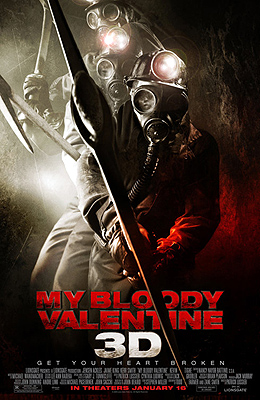
 My Bloody Valentine / My Bloody Valentine 3-D (2009) **½
I figured there had to be one, right? Out of all the unasked-for remakes of major 70’s and 80’s horror films that flooded theaters between 2003 and 2012 or thereabouts, surely there was one that wasn’t materially worse than its inspiration, and maybe even improved on it in some respects. It makes sense, too, that it would be My Bloody Valentine, because the old version owes its status as one of the better boom-time slasher flicks as much to the feebleness of the competition as to its own intrinsic merits. The original My Bloody Valentine was a decent enough movie, but not one that should have been difficult to match— or even to top, for that matter. It therefore speaks volumes for the 21st-century horror remake project as a whole that this My Bloody Valentine equals its predecessor on average, rather than across the board. The remake fixes a few of the original’s mistakes, but also repeats enough of them while committing whole new errors of its own that it only just clears even that very forgiving benchmark.
The nonspecifically Appalachian village of Harmony basically wouldn’t exist without the Hanniger coal mine, and the townspeople are ambivalent about both the mine and the family that owns a controlling interest in it. Such sentiments are only natural for residents of a place where the best way to earn a living is dirty, dangerous, and exploitive. Tom Hanniger (Devour’s Jensen Akles), scion of the current Hanniger patriarch, therefore has two strikes against him from jump when he goes to work down in the tunnels upon graduating from high school— first because he’s the boss’s son, and secondly because his particular duties place him in petty authority over men much older and more experienced than him. The third strike that makes all of Harmony turn on Tom is an accident leaving five miners trapped behind a cave-in, which never would have happened but for Hanniger straight-up forgetting to do a routine part of his job at the worst possible time. The ill-feeling in town further intensifies when rescue excavations turn up only a single survivor— a veteran coal-digger by the name of Harry Warden (Richard John Walters, from Valentine Bluffs and Breeding Farm)— and him in a coma. But then a fact comes to light complicating the emergent “blame the rich kid” narrative. The four dead miners weren’t killed by the cave-in, nor did they succumb to suffocation or thirst while waiting to be freed. Their heads were all stove in with a pickaxe, and the only possible culprit under the circumstances was Harry Warden. The people of Harmony have only a little while to digest that revelation, though, before Warden emerges from his coma, slaughters his way out of the hospital, and makes a beeline for the Hanniger mine, where the younger members of the staff are throwing a Valentine’s Day party in the disused Tunnel #5. Warden kills most of his erstwhile coworkers, too, before his rampage is interrupted by Sheriff Burke (Tom Atkins, of Two Evil Eyes and Escape from New York). Burke doesn’t actually capture or kill the maniac, however. Warden flees deeper into the mine, the sheriff loses track of him, and he’s never seen again dead or alive.
Ten years to the month later, the few survivors of Warden’s attack on the mine are having decidedly mixed success in getting on with their lives. Axel Palmer (Kerr Smith, from Final Destination and The Forsaken), Tom Hanniger’s longtime rival as the son of the mine’s second-biggest shareholder, is Harmony’s sheriff nowadays. That puts him on the high end. He’s no longer with the girl he was dating back in the day, though, because Irene (Betsy Rue, of Lucky Bastard and Halloween II) is now pursuing an exciting career as Harmony’s foremost truckstop slut. Instead, Axel went and married Sarah (Jamie King, from Mother’s Day and The Tripper), who used to be Tom’s girl— and you’d best believe that Axel is still endzone-dancing over that coup, even as he cheats on Sarah with Megan (Megan Boone), the cutest of her employees at the grocery store that she manages. As for Tom, he dropped straight off the map after the Harry Warden business reached its bloody conclusion. Tom skipped town without telling a soul where he was going, took a silver medal in the Fucking Up Your Life Olympics, and (although he naturally keeps this aspect of his adventures in the big, wide world under his hat), spent seven of those ten years committed to a mental hospital. He’s come back to the old hometown now, however, because Old Man Hanniger has died, leaving Tom heir to the family’s stake in the Hanniger mine. Tom has no desire to be a coal baron, though. All he wants is to sell out his newly inherited holdings as quickly as possible, severing his ties to Harmony once and for all. Mind you, that plan makes him even less popular in town than he already was, because the only people who buy coal mines nowadays are vultures and vampires who just want to strip them for parts. By selling out, Tom is effectively condemning the community to a slow, strangling death by layoffs and deindustrialization. Sarah says so directly, too, when she defies her jealous husband and agrees to meet with Tom. That conversation doesn’t immediately change Hanniger’s mind, but it does get him thinking that maybe there’s still something for him in Harmony after all. Sarah’s anger very obviously wasn’t the only thing throwing off sparks, you see.
Tom might not have been alone in his homecoming, however. On the very same night that Hanniger checks in at the Thunderbird Motel, Irene and her latest truck-driving paramour (co-writer Todd Farmer, whose other onscreen credits include Jason X and Trick) are killed in the middle of a lovers’ spat together with the motel’s proprietor (Selene Luna, from Demonic Toys: Personal Demons and Gingerdead Man III: Saturday Night Cleaver) by someone exactly recapitulating Harry Warden’s old modus operandi. This same killer drops in at the mine the next day, his arrival coinciding with the visit whereby Tom was hoping to finalize his decision on whether or not to sell. Indeed, Tom witnesses that second murder, and jumps at once to the outwardly plausible conclusion that Warden is back. Axel, however, knows a long-buried secret that ought to rule out such a thing, so when he begins investigating the case, the conclusion he jumps to is that Hanniger himself has turned copycat killer. Truth be told, the circumstantial case against Tom is pretty good— good enough to suggest a deliberate frame-up. If that’s what’s going on, though, it should be obvious to everybody, Tom and Sarah included, that Axel is the very person with the strongest motivation to pin the killings on Hanniger. So which is it? Is Tom still crazy enough that we in the audience should treat any scene that unfolds from his point of view as an unreliable depiction of events? Has Axel been driven so far over the edge by Hannigers’s return that not even people he cares about are safe if sacrificing them would create an opportunity to harm his old rival? Or did Harry Warden somehow find a way out of the DIY grave in the woods around Harmony where a vigilante posse led by Sheriff Burke left him ten years ago, unbeknownst to any but a tiny handful of townspeople?
Probably the biggest surprise about this My Bloody Valentine is that it follows its predecessor in taking its murder-mystery aspect fairly seriously, keeping the killer’s true identity in genuine doubt until the climax. The least surprising thing is that the solution is once again an unsatisfying cheat— albeit a different unsatisfying cheat from the one we got the first time around. That dichotomy is pretty much this movie in a nutshell. Every cause for praise comes packaged with some countervailing unforced error which diminishes the impact of whatever My Bloody Valentine might have done to impress you.
Take something as basic and seemingly hard to fuck up as the kills, for example. After all, this being a slasher movie, those are rather important. The original My Bloody Valentine got positively mauled by the MPAA ratings board, so that only quite recently did it become apparent what a boundary-pushing shocker it really was. Director Patrick Lussier and effects designer Gary J. Tunnicliffe took it as part of their remit for the remake to create anew some of the appalling carnage that audiences got cheated out of in 1981, while simultaneously challenging themselves to devise their own comparably inventive affronts against human anatomy. Mostly they did a good job, but the mere quantity of murders in this movie undercuts their individual impressiveness, especially during Harry Warden’s post-awakening rampage. Eventually it all just blurs into an onrushing wave of blood and giblets, you know? The volume of the violence also feeds into what I was saying before about cheating the mystery, because once the killer’s identity is established for certain, it becomes obvious that he shouldn’t have any reason to want several of these particular victims dead, even subconsciously. And maddeningly, the incident that suffers most from that effect is the triple murder at the Thunderbird Motel, which in and of itself is a bravura sequence melding shock, suspense, black comedy, in-your-face titillation, and sheer bad taste in a way that I thought the 21st century had completely forgotten how to carry off.
Again, that sort of good news/bad news tradeoff occurs throughout My Bloody Valentine. The cast is almost universally superior to their counterparts from 1981 in terms of technique, but none of these performers save Tom Atkins and Selene Luna can muster up the hardscrabble working-class vibe that this story so obviously requires. My Blood Valentine is one of the few horror remakes of its era to eschew any awful excess of digital color timing (No Rustorama! No Mucuscope! None of That Damned Blue Filter!), but then it irritates the eye instead with tryhard frame compositions meant to exploit the Real-D 3-D process. (To be fair, though, a couple of those are clever enough to add genuine visual interest, as opposed being just a cheesy gimmick.) Perhaps most commendably, writers, director, and actors alike put major effort into portraying all the central characters as severely damaged, flawed, and compromised by their collective brush with Harry Warden, without letting them become just repellently shitty people. But even that has its downside, because none of that nuanced characterization ever really interacts with or informs the plot except in the crudest and laziest of ways. The bar for slasher movies is low enough that My Bloody Valentine clears it with plenty of room to spare, but the unrealized potential here cries out for recognition, maybe even more than it did 28 years earlier.

Home Alphabetical Index Chronological Index Contact
