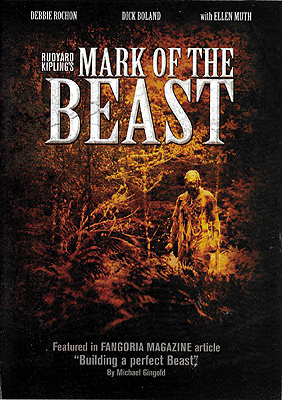
 Mark of the Beast / Rudyard Kiping’s Mark of the Beast (2012) **
Nobody really thinks of Rudyard Kipling as an author of horror stories. A poet, yes. An adventure writer, certainly. A purveyor of fables and fantasies for children, sure. An interpreter of Indian culture for Victorian Anglophones most definitely, and a propagandist for English colonialism above all. But a horror writer? No. Nevertheless, Kipling did occasionally work in that mode, and his spook stories warrant more attention than they usually receive. In them as in his war poetry, he sometimes let the mask of great-power militancy slip to reveal a profound disquiet over the moral cost of empire. “Mark of the Beast” is my favorite of the lot, partly because it’s just a bracingly nasty tale of fucking around and finding out, but also because it’s the closest I’ve ever seen Kipling come to openly admitting that John Bull and Queen Vicky might, just maybe, be the baddies. I got very excited, then, when I realized that Jon Gorman and Thomas Edward Seymour’s Mark of the Beast was based on that “Mark of the Beast.” I wasn’t sure what to expect, since I knew going in that a faithful adaptation would be orders of magnitude beyond the means of any filmmaker operating, as Gorman and Seymour do, in the gray zone between indie and micro-budget. But it never occurred to me that someone who’d take the trouble to adapt such an obscure story in the first place could miss its point so completely. Maybe that makes me a sucker for seeking an intelligent, perceptive take on Kipling from the dudes behind the Bikini Bloodbath series.
Sheriff Strickland (Dick Boland, from Bikini Bloodbath and The Land of College Prophets) is hosting a New Year’s Eve party at his riverside cottage in some unidentified woodsy nowhere— and when I call it that, I don’t just mean that the property sits far removed from any other sign of human activity. Gorman and Seymour have dealt with their inability to afford a trip to India by disconnecting Mark of the Beast from any intelligible geographic setting whatsoever. The needless and intrusive voiceover narration by Strickland’s longtime friend, Debbie (Debbie Rochon, of Regenerated Man and Terror Firmer), speaks of “natives” with whom the sheriff is well acquainted in the course of his duties, and identifies them as worshipping “heathen gods”— almost exactly as if this were supposed to be the foothills of the Himalayas in the late 19th century. But the time is the present day, the actual shooting locations are in Connecticut, and from what little we ever see of these so-called natives, they have no characteristics whereby they could be assigned to any indigenous population on Earth, real or imaginary. Be that as it may, Strickland hasn’t just invited locals to his shindig. His wife, Sheri (Sheri Lynn, of Bikini Bloodbath Car Wash and Bikini Bloodbath Christmas), has a friend from before the marriage by the name of Maggie (Margaret Rose Champagne, from The Changed and Diane), and Maggie has brought along a much younger girl called Natalie (Dolores Claiborne’s Ellen Muth) who seems to be going through a rough romantic patch just now. Maggie and Natalie both live far enough away that the Stricklands will be putting them up for the night at their place.
And then there’s Fleete (Phil Hall, from My Mouth Lies Screaming and Abduction). Fleete is primarily Debbie’s friend, near as I can tell. He recently inherited a plot of land on the far side of the forest from Strickland’s, a distance of some four miles, although his acquaintance with the sheriff predates that by long enough that this isn’t his first New Year’s by the riverbank. But what’s immediately obvious about Fleete is that he’s going to be trouble somehow or other. For one thing, he’s spent all his life in an urban setting, and the woods make him squirrelly. He also admits to dreading the natives, although he can offer no explanation as to why he should. And perhaps most ominously of all on New Year’s Eve, Fleete drinks to fantastical excess— to the point that he claims not to remember ever having attended one of Strickland’s parties before! The big lush lives up to his usual pattern on this occasion, pounding them down until all the other guests save Debbie, Maggie, and Natalie have left, and ringing in the new year in such a state of inebriation that he’ll still be three sheets to the wind when he awakens in the morning. Obviously there’s no prospect of him making it home under his own power, but neither will Strickland be giving him a lift. That’s because the moment the sheriff makes that offer, Fleete seizes his car keys, and hurls them into the river. I guess it’s Strickland’s sofa for Fleete tonight, huh?
Fleete continues making a nuisance of himself in the morning, when Debbie and Strickland try to help him stagger, still plastered, four miles through the woods to his front door. No more than halfway there, the trio encounter a shrine to the natives’ monkey god. (This is explicitly Hanuman in Kipling’s telling, but in Gorman and Seymour’s? Who knows? If there’s one clade of mammals that I’d never expect to find in those woods, it’s monkeys.) Fleete treats the altar as a great, big joke, mocking it incoherently and even stubbing out his cigar on it. No sooner has he done so, however, than he gets tackled by a leper, of all things! This guy (Marc Bovino) has clearly been leping for quite some time, too, for both his hands have rotted away to fingerless stumps, and apart from his mouth, his face is nothing but a featureless mass of pustules. The leper releases Fleete after a brief grapple, upon which the big jerk’s increasingly rattled friends turn around and drag him back the way they came as fast as possible. Then Fleete goes into the bedroom previously occupied by Maggie and Natalie to sleep off the remainder of his drunk.
It quickly becomes apparent, though, that Fleete isn’t merely drunk— now he’s sick, too. He develops a worrisome fever, and a cluster of angry-looking sores appears on his chest. Then when Fleete drags himself out of bed just a few hours before sunset, he’s ravenous and ill-mannered, devouring one pork chop after another with his bare hands and teeth, and berating Sheri testily if she serves them to him cooked any more than is necessary to raise the temperature of the meat to that of a freshly killed animal. Debbie and Strickland are deeply disquieted, fearing that Fleete may have caught some disease from the leper in the forest, but even now their ordeal is just beginning. When the sun goes down, Fleete’s human personality vanishes along with it, leaving him transformed in spirit, if not in body, into a vicious, predatory beast. Indeed, he goes so far as to bite Maggie before the others are able to bring him under control. The doctor whom Strickland summons (Matt Ford, from Seven Mummies and Thrill Kill Jack in Hale Manor) proclaims Fleete afflicted with rabies, but muses that the man’s condition, in detail, is unlike any case of that disease he’s ever seen before. Maggie, meanwhile, begins to sicken as well, but her symptoms are different. Rather than turning feral as one would expect if Fleete really were rabid, she merely falls into fever and delirium, as if her blood had been invaded by ordinary bacteria from the man’s mouth.
The longer Debbie and Strickland watch Fleete, the more convinced they become that what ails him is more than natural, but they find themselves at loggerheads over what to do about it. Strickland, devout Christian that he is, thinks in terms of demonic possession, and proposes a do-it-yourself exorcism as the solution to the problem. Debbie, whose lack of particular religious convictions makes her readier to concede the possible existence of other people’s gods, wants to track down the leper, and force him to lift the curse which she believes he laid on Fleete. And when Strickland’s preferred approach fails, there’s very little that either of them will scruple at in their efforts to induce the leper to rescind his hex.
Yes, that’s right. Jon Gorman and Thomas Edward Seymour have turned Rudyard Kipling’s cautionary tale about disrespecting the cultures of peoples whom yours have conquered into a janky Exorcist clone, with a side order of post-“24” hand-wringing over the circumstances in which torture might become permissible. It makes Mark of the Beast the most thoroughly wrong-headed adaptation I’ve seen in a while— especially since I can so easily imagine a way to transpose the original story to a modern American setting with all its themes and subtext intact. The United States has Indians of its own, after all, and has treated them even worse than the British treated the people who more rightly own that name. Do a little research on the local tribe to work out what grave cultural disrespect a drunken asshole could offhandedly commit out of sheer callousness, and you’re good to go. Indeed, this story might even work better with Native Americans as the oppressed underclass. After all, the point of the leper’s curse is to turn Fleete into the very thing that he, in his arrogant ignorance, considers the natives to be, and wild animal imagery figures in racist depictions of Native Americans much more prominently than it ever did in racist depictions of Indians in the strict sense. With this portrayal of the indigenes as hypothetical non-people from a hypothetical non-place, Gorman and Seymour might as well be going out of their way to prevent Mark of the Beast from meaning anything, even by accident.
Considering how determinedly the filmmakers ran away from Kipling’s setting, themes, and even basic characterization, it’s very strange that they simultaneously incorporated great masses of the source tale’s actual text, whether as dialogue or as voiceover narration. It wasn’t a good idea. “Mark of the Beast” was published in 1890, and its 19th-century British prose sounds impossibly stilted and unnatural in the mouths of these 21st-century Americans— especially when they have to shift gears between Kipling quote and ordinary vernacular speech within the space of a single line, as happens far too often. The narration might be even worse, because there’s simply no reason for it to be here at all. Except when Debbie talks about Fleete’s background early on, nothing she says in voiceover conveys any information that couldn’t be extracted from the action onscreen, and even that one bit of useful exposition would likely have benefited from being shifted to the dialogue. Also, regardless of its format, the ported-over text reduces the entire cast to mere recitation whenever they come up against it, like eighth-graders encountering Romeo and Juliet for the first time.
The bad creative decisions are doubly frustrating, because Mark of the Beast is far more technically accomplished than I’m used to seeing from this sort of glorified backyard production. Gorman and Seymour took a deliberately antiquated approach to visual pacing, favoring long, slow takes without a lot of busy cutting, and allowing the viewer to appreciate thereby the lonely atmosphere of the Connecticut countryside. Although they overdid the artificial digital color timing in that characteristic modern way, they at least made the unusual choice to adopt a warm, brown-heavy palette suggestive of cheap 1970’s film stock that’s starting to fade to sepia. The makeup effects for the leper are impressively gross, even if I’m not sure they really evoke leprosy specifically. And most surprising of all, Glen Gabriel’s score sounds like proper-ass movie music, toggling between creditable impersonations of Bear McCreary and Hans Zimmer. It has a hugely disproportionate effect on how Mark of the Beast comes across, for although I’m pretty sure Gabriel played the whole thing on a synthesizer, he obviously used a high-quality sampling synth, and understood its capabilities backwards and forwards. It sounds enough like a real orchestra playing real instruments to fool the ear on the first pass, and it makes the entire project feel more lavish and professional than it could possibly really have been.

Home Alphabetical Index Chronological Index Contact
