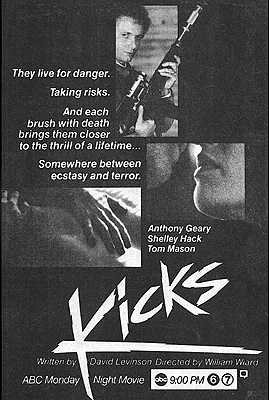
 Kicks (1985) ***
This is a topic for another day, but the movie that Adrian Lyne made out of Ingeborg Day’s 9½ Weeks is nothing like the book tonally, and resembles it only superficially as to subject matter. It was also most of a year late in coming out, as Lyne recut it over and over again in search of a version that wouldn’t empty out a test screening faster than a basket of live gaboon vipers tossed into the auditorium. 9½ Weeks had buzz while it was in production, though, combining as it did intriguingly controversial source material and one of the hottest younger leading men in Hollywood. That made it a natural target for copycats, while its torturous post-production introduced the delectable possibility of a knockoff beating it into general release. I would never have imagined, however, that one of those quickdraw knockoffs could been made for broadcast television— let alone that the pressures of network censorship could force Kicks to come out truer to the spirit of Day’s 9½ Weeks than Lyne’s official adaptation!
We begin in one of the San Francisco Bay Area’s finer ghettos (somehow the place feels more like Oakland to me than Frisco proper), where business financing pimp Martin Cheevers (Anthony Geary, of Blood Sabbath and The Amazing Captain Nemo) is having a hard time starting his Ferrari. A man with money in obvious distress is a magnet for trouble in a neighborhood like this, and Cheevers soon finds himself surrounded by knife-wielding ruffians who propose to help themselves to both his wallet and his car. All is not as it seems, however. Cheevers is a trained fighter whose hands, soft though they may be, are formidable weapons. He makes short work of the whole gang, appropriates their leader’s switchblade as a trophy, and speeds off (his car now starting up just fine, thank you very much) to his hyper-luxury apartment in a substantially cushier district.
Meanwhile, one doesn’t normally expect to find adrenaline-addicted thrill jockeys among university English departments, but permit me to introduce Dr. Maggie Pierson (Shelly Hack, from Troll and The Stepfather). Maggie skydives. She rides a motorcycle on her commute across the Golden Gate Bridge from her home in the Marin Headlands. And try as her department chair, Rosemary (Susan Ruttan, of Bad Dreams and Bay Cove), might to groom her as a successor, Maggie has no taste whatsoever for administrative or academic politics. For that matter, Pierson isn’t crazy about teaching, either, but at least in the classroom, she gets to be more or less her own mistress. That drive to adventure and aversion to respectability carries over into Maggie’s romantic life as well, where she maintains an iron determination to thwart the efforts of her boyfriend, Caleb (Tom Mason, from The Aliens Are Coming and The Puppet Masters), to marry her. If she sounds to you like exactly the sort of gal that would fall for a guy who Q-ships muggers for fun, then you’re already a step ahead of the plot.
Pierson comes to Cheevers’s attention one afternoon while he hangs out observing the action beside the runway at her preferred skydiving venue. Immediately liking the cut of her jib, Martin assigns his butler, Barnes (Ian Abercrombie, of Sole Survivor and The Ice Pirates), to scope her out. Maggie’s first indication that she’s being targeted by a rich man on the make is the single, red, longstem rose that she finds on her lectern one day, together with a second one on her desk in the faculty office. Then, as she mounts her motorbike at the end of the workday, she finds Martin himself waiting for her just outside the parking garage, bearing yet a third rose and radiating wealth, privilege, and masculine arrogance. Maggie agrees to go out to dinner with him the following night.
All first dates are tests of a sort, but Martin turns out to be probing Maggie for something far more particular than taste, ideological compatibility, or spiritual alignment as those things are usually understood. What he wants to know is how she feels about risk and danger, and he’s arranged an experiment that will tell him more, and with greater accuracy, than any mere conversation ever could. Before leaving the restaurant, he excuses himself to make a phone call— but rather than phoning Barnes or some business contact, he dials 911 to report his Ferrari stolen. Then on the way back to Maggie’s place, he drives aggressively enough to attract the notice of a traffic cop, whom he provokes into a nigh-suicidal high-speed chase through the San Francisco street grid. Ducking into a parking garage just far enough ahead of the police to ensure that he and Maggie won’t be spotted, he ditches the car, hails a taxi, and rides aimlessly around the city until it’s plausible to imagine Barnes receiving word that the “stolen” Ferrari has turned up. Then he and Maggie return to the garage to collect the car as if this were the first they’d seen of it all night. Now if Martin had just asked whether running a high-stakes practical joke on the SFPD was her idea of a good time, Maggie would certainly have said no. Now that she’s actually lived through it, though? Maggie’s hooked, and the next time she sees Caleb, she informs him that she’s no longer interested in pursuing their relationship. Nor is she inclined to listen a day or two later, when Caleb tells her that Martin Cheevers is a notorious man in the Bay Area business press, surrounded in all his actions by a miasma of vaguely suspected illegality.
Maggie’s relationship with Martin is thus built from the start around the both of them double-dog-daring the dice in an ever-escalating manner— and double-dog daring each other as well. They make tactfully offscreen love high up in the exposed skeleton of an unfinished skyscraper for which Cheevers lined up the funding. They go skydiving together, pushing the limits of how low a parachute can open without leaving the user chunky-style upon landing. In the film’s most incredible scene, they play a game of reflexes against an Indian cobra, taking turns plucking quarters out of its basket until either they run out of coins or the snake gets in a good bite! But those much-taunted dice finally come up snake eyes when Martin and Maggie stage a simulated heist on the Valoire Jewelry Exchange (another company to which he evidently has preexisting ties), breaking in late one night to jimmy the diamond safe. A security guard catches the couple in the act, and Martin shoots the old man dead.
The situation is even more fucked up than Pierson realizes, however. Cheevers meant for them to get caught playing Ocean’s Two. He meant to kill that night watchman. And most importantly, he meant for Maggie— but not himself— to be seen by the closed-circuit television cameras in the vault office when the killing shot was fired. It was mostly serendipity, though, how perfectly the framing of the video recording makes it look like Pierson was wielding the pistol. The reason why Martin has pulled this horrendous dirty trick is that he’s been preparing Maggie all along for a game that even she would never agree to play without the impetus of blackmail. That’s right— Cheevers is about to give up impersonating Mickey Rourke in favor of impersonating Count Zaroff!
In Ingeborg Day’s 9½ Weeks, the protagonist reaches her breaking point in the relationship when her freaky dom boyfriend has her dress up in male drag to mug a complete stranger at knifepoint. Adrian Lyne shot a version of that scene that was arguably even more perverse than the one in the book, plus another, equally disturbing one pitting the two lovers against each other in a pill-swallowing contest in which only the man realizes that the drugs are really just breath mints. Test audiences, however, hated those even more than they hated the scene in which Mickey Rourke makes Kim Basinger crawl around a hotel room on her hands and knees, picking up dollar bills that he scatters in front of her. Both were cut from the wide-release version, which is one of the reasons why it feels so fecklessly tame. Kicks, you will notice, includes obvious analogues for both of the deleted episodes, and that illustrates the surprising secret to its success.
When I first heard about Kicks, it was presented to me as an outrageously unlikely chapter in the prehistory of the erotic thriller. It certainly can be interpreted that way, but to do so is to name explicitly the very thing that sets this movie apart from both later entries in that genre and Lyne’s 9½ Weeks: because Kicks was made for network TV, it couldn’t include more than trace amounts of eroticism in the ordinary sense of the word. Maggie and Martin can’t be seen to fuck, so their kinks have to express themselves outside the bedroom, where they inevitably become much more twisted than they could ever have been inside it. Even before Cheevers sets in motion the climactic death-race to Alcatraz, it’s obvious that their relationship is unhealthy in ways that mere sexual perversion could never equal— and yet we’re left in no uncertainty whatsoever that for these two, courting death, imprisonment, and reputational ruination together has become its own form of sexual intercourse. And from there it follows naturally enough that the shift into Most Dangerous Game territory operates not merely as attempted murder, but also as a kind of rape.
The sublimation of sexual desire into other forms of thrill-seeking puts a lot of pressure on both Shelley Hack and Anthony Geary. For Kicks to work, neither one of them can ever afford to let a cigar be just a cigar, but they also can’t just come right out and act horny. Even leaving aside any thematic considerations, Standards and Practices wouldn’t have it. Meanwhile, the two actors have to keep this extreme relationship both emotionally and psychologically plausible. I’m honestly not sure which success impresses me more, but I think maybe I expected the latter less. The way Shelley Hack plays her, Maggie genuinely seems like the kind of person who’d fall for a vast, flapping bunting of red flags like Martin Cheevers, and although Anthony Geary benefits from the license to overdo it that generally comes with the villain’s role, he keeps a tight enough rein on himself during the first and second acts to remain broadly convincing. What might be most remarkable of all, though, is how Kicks stops noticeably short of condemning the prickly independence and rejection of conventionality that set Maggie on the path to her Alcatraz showdown. Despite his best efforts, Caleb’s pre-climax bid to ride to her rescue accomplishes about as much as the typical slasher-movie love interest’s intervention on behalf of the Final Girl, so that Pierson remains dependent solely on her own resources of mind and spirit at the last. The character traits that got her into this mess are also the only things that can get her out of it in one piece.

Home Alphabetical Index Chronological Index Contact
