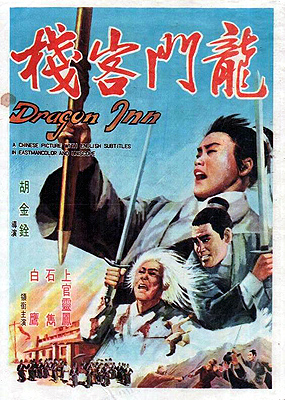
 Dragon Inn / Dragon Gate Inn / Breakthrough / Long Men Kezhanr (1967/1968) ***
For all that Shaw Brothers in its 1970’s heyday focused on cultivating and retaining bankable talent, both in front of and behind the camera, that hadn’t been nearly so much the case in the 50’s and 60’s. Indeed, studio boss Run Run Shaw had something of a knack back then for chasing off key directors. Take King Hu, for example. Hu joined Shaw Brothers 1958, working as everything from set decorator to actor to screenwriter, but it was only in 1964 that he was grudgingly extended the chance to direct a film of his own with The Story of Sue San. A picture in the style of Huangmei opera*, The Story of Sue San fell broadly into line with Shaw Brothers’ early-60’s corporate identity as a factory for musicals, and it did well enough to win Hu two more directing gigs. And since Hu’s third feature, Come Drink with Me, initiated a genuine revolution in Chinese-language cinema, one can understand the director’s ire at being paid just $2500 HK for his work on it despite the flood of money that it poured into Shaw Brothers’ coffers. Just the same, there was no longer anyplace in Hong Kong where a disgruntled Shaw employee might profitable settle, thanks to the 1964 plane crash that decapitated the rival Cathay Organization, killing chairman Loke Wan Tho and most of his top executives. There were, however, just such refuges available across the South China Sea in Taiwan— and Hu already had connections at one of them.
The Union Film Company had been set up in 1953 as a distribution firm, importing movies from Hong Kong and Japan for a country that at that time had little in the way of indigenous film production. Union’s main buyer in Hong Kong, Zhang Taoran, was a friend of Hu’s, and it just so happened that he was interested in launching the company into the business of making movies instead of just distributing them. In 1966, Zhang approached Hu about moving to Taiwan to become Union’s chief of production, sweetening the deal further by offering him the equivalent of $18,000 HK per film to double as a director. Although Hu’s initial contract with Union was good for just two years, he ended up making the firm his professional home until 1973 or thereabouts, after Golden Harvest established itself as a serious competitor to Shaw Brothers back in Hong Kong. Hu demonstrated the wisdom of Zhang’s investment in him right out of the gate. His first movie for Union Film, Dragon Inn, continued the reinvention of wuxia begun by Come Drink with Me, and is now generally regarded as a classic of the form. Noticeably more self-assured as an action picture than its Cantonese predecessor, Dragon Inn gives fans of cinematic fisticuffs considerably more to appreciate. And although it’s too overstuffed to serve very well as a showcase for individual performers the way Come Drink with Me spotlighted Yueh Hua and Cheng Pei-Pei, it makes up for that by heralding the kind of ensemble that Chang Cheh would perfect in the decade to come with the Four Pillars and the Venom Mob.
A lengthy opening narration sets Dragon Inn in the year 1457, a momentous one for the history of the Ming Dynasty. That was when Emperor Yingzong began his second reign, putting an end to a long-running game of musical thrones. Briefly, Yingzong had been captured eight years earlier while leading an army in calamitously failed defense against an invasion by the Oirat Mongols. His brother, Zhu Qiyu, ascended the throne as the Jingtai Emperor, and entrusted the battle against the Oirat to the exceedingly capable Vice-Minister of War, Yu Qian (or Yu Chien in the Romanization scheme current in the mid-1960’s). Yu repelled a Mongol assault on Beijing in a heroic display of military acumen and personal courage, but there was one slight problem with his triumph. During his captivity, Yingzong had won the favor of the Oirat khagan, Esen Taishi, and the two rulers had come to an understanding about the future relationship between their domains. When Esen marched on Beijing, one of his aims was to return his captive to power, so Yu’s mighty resistance became an act of treason in Yingzong’s eyes. The throneless emperor (officially declared “emperor emeritus” by his brother) never forgot or forgave, even after he was released into the custody of the imperial court and placed under house arrest in the Forbidden City’s Southern Palace together with his numerous wives and consorts. Once the Jingtai Emperor was deposed in a palace coup, the reinstated Yingzong wasted no time in having Yu executed. And that’s where Dragon Inn begins: with Yu Chien (Chia Lu-Shih, from A Touch of Zen and The Ghost Hill) getting beheaded by a kangaroo court presided over by the eunuch Tsao Shao-Chin (Pai Ying, of Iron Petticoat and Fist of Shaolin), a purely fictional chief of the Eastern Bureau secret police force.
Chinese martial arts movies generally don’t dramatize history so much as rhyme with it, however, and in this version of events, Yu Chien has a daughter (Hsu Feng, of Shaolin Kung Fu Mystagogue and The Invincible Sword) and two sons (Yu Chi-Kung, from Na-Cha and the Seven Devils and Black Invitation, and Chaai Wai). They’re all just teenagers now, but Tsao naturally anticipates trouble from them down the line. Nevertheless, his remit from the emperor doesn’t countenance the execution of juveniles. Rather, the Yu children are to be banished from the realm via the Dragon Gate, evidently an opening in the Great Wall near the margin of the Gobi Desert. There’s opportunity for Tsao in that sentence, however, for the land beyond the Dragon Gate is a lawless one where the small squad of soldiers escorting the exiles might fall prey to bandits, Mongol raiders, or pretty much any human or natural hazard you could name. Tsao engages his right-hand man, Pi Shao-Tung (Miao Tian, from Half a Loaf of Kung Fu and The Last Duel), to disguise his men as a plausibly deniable troop of ruffians, and to eliminate the Yu siblings before they can grow up to seek revenge on their father’s behalf. The assassination goes awry, though, when the kids and their escorts are rescued by roving brother-and-sister kung fu masters Chu Chi (Hsueh Han, from One-Armed Boxer and The Knight of Old Cathay) and Chu Huei (Polly Shang-Kuan Ling-Feng, of The Brave and the Evil and The Zodiac Fighters).
Nevertheless, Pi isn’t the sort to leave a job unfinished. He knows that there’s an inn near the outside of the Dragon Gate, run by a cantankerous fellow called Wu Ning (Tsao Chien, from Vengeance of Snow Maid and The Shadow Girl). It would make a tempting hideout for fugitives, and an equally attractive base of operations from which to search the surrounding countryside in the event that the Yu kids and their protectors aren’t already there. Pi occupies the inn at once, ordering the staff to turn away all other customers for the duration of his and his soldiers’ stay. But because there is indeed no sign of the Yu siblings when he arrives, Pi leaves a skeleton guard at the inn under the command of Mao Tsun-Hsien (Han Ying-Chieh, of Fists for Revenge and Bloody Sorcery), and begins scouring the desert with the bulk of his force.
That’s when Hsia Shao-Tzu (Shih Chun, from The Grand Passion and The Devil Design) arrives at the inn. He claims to be a friend of Wu Ning’s, and he refuses to leave without speaking to him. And when Mao truthfully explains that Wu isn’t on the premises, Hsiao simply takes a seat and announces that he’ll wait, deflecting Mao’s objection that the inn is full by pointing out that he didn’t ask to rent a room. Considerably smarter than he looks, Mao concludes that this affable yet stubborn stranger means trouble. He sends a man to the kitchen to add a dose of poison to Hsiao’s wine, but Mao won’t be rid of the unwanted guest that easily. The hostile demeanor of everyone at the inn save the employees themselves is unmistakable, and Hsiao is sufficiently on his guard to realize that the waiter’s reluctance to hand over his wine means something. Hsiao merely pretends to drink, then tests his surmise that the booze has been tampered with by faking a fatal seizure. When the poisoner comes over to inspect his handiwork, Hsiao springs into action, and demonstrates that he’s more than a match for Mao’s whole squad. Only the return of Pi Shao-Tung prevents really extensive bloodshed, because Pi is sharp enough to recognize when an approach to a problem isn’t working, and is credibly positioned to act as an authority figure swooping in to de-escalate. Pi ingratiatingly explains that he and his men are Ministry of Justice officials on the trail of desperate criminals, and that Mao’s actions stemmed from an overly zealous interpretation of their orders. Now that Hsiao understands the situation, perhaps he’ll also understand that he really must leave the inn so that the imperial agents can get on with their work? This time, Hsiao acquiesces without struggle or complaint— but don’t you go thinking he actually believed a word that Pi said!
No sooner has Hsiao departed, however, than he encounters Wu Ming in the hills overlooking the inn. Hsiao warns his friend about his un-neighborly new customers, and accompanies the older man when he goes to resume his hands-on role as innkeeper. Pi can’t very well object to that, can he? Soon thereafter, though, along come another pair of would-be guests whom the Eastern Bureau agents would prefer not to admit. The irony here is that these two are none other than Chu Chi and Chu Huei, scouting ahead to see if the inn is a safe place for the Yu kids and their escort to stop and rest. If Pi would but put on a sufficiently welcoming front, they’d lead his quarry right to him! In any case, Chu Chi never takes no for an answer without a great deal of persuasion, nor is he the sort of man in whose face you close a door if you value your hinges. He and his sister will be staying at the inn whether the secret police want them or not. Furthermore, Mao has no better luck poisoning their wine at dinner than he had with Hsiao’s that afternoon— although that deadly drama plays out with comic disingenuousness on both sides. Still, Pi has to realize that something is up from the way rogue kung fu masters keep horning in on his preparations to trap Yu’s heirs, and he sends word back to Tsao Shao-Chin. The nature and extent of the conspiracy against the Eastern Bureau is currently unknown even to most of the conspirators themselves, however. The only one who fully understands what’s happening, or what’s about to happen, is Wu Ming.
Wu was a soldier before he got into the hospitality business, and the officer under whom he served in those days was none other than Yu Chien. Not only that, one of Wu’s fellow grunts was a man called Chu— the father of Chi and Huei. Indeed, the rescuers of Yu’s children knew Wu when they were just kids themselves, although they don’t recognize him now. The upshot is that Wu’s loyalty to his old commander, Hsiao’s friendship with the innkeeper, and the Chu siblings’ Confucian filial piety have combined to assemble at the inn a potent force in opposition to the cruel and crooked secret police. And by summoning his master to take personal charge of the situation, Pi has played right into Wu’s hands, even if Tsao Shao-Chin’s own martial prowess is such that final success in the plot to avenge Yu Chien is far from assured.
The biggest reason why my wuxia project is progressing so much slower than my earlier delving into the first decade or so of kung fu movie development is because wuxia films have so many moving parts that I find them mentally taxing to watch. Hordes of characters, labyrinths of secret motivations and/or identities, plots that intersect with but don’t necessarily follow centuries’ worth of history that I understand poorly if at all— it’s a lot to keep track of! Throw in unfamiliar cultural context cues, sprawling running times, and the extra cognitive load of subtitles, and you should be able to see why watching wuxia (let alone writing about it) requires of me considerably more psychic loin-girding than most other genres.
It was worth it for Dragon Inn, though. This movie builds on everything I enjoyed about Come Drink with Me, while dispensing with ill-fitting curlicues like Drunken Cat’s singing orphans. The major players display greater comfort with cinematic swordplay, leaving Hu freer to simply film the fight scenes instead of trying to construct the action entirely in the editing bay. Union Film had nothing to equal Shaw Brothers’ Movietown complex, but Hu turns that to his advantage by relying on location shooting in places where the terrain is simply breathtaking. The stark transition from green hills to the arid plain below mutely but unmistakably conveys the status of Wu’s inn as the final outpost of Somewhere on the edge of a vast and hostile Nowhere— as a place where unscrupulous government officials can do as they will without heed to the niceties of the law, but where they could also vanish into the mists of history should they try doing it to someone more dangerous than themselves. Best of all, Hu and his cast collaborate deftly on the characterization of heroes and villains alike. Shih Chun, Tsao Chien, Hsueh Han, and Polly Shang-Kuan Ling-Feng gradually combine into a solid ensemble of sharply distinct but mutually reinforcing personalities, in which the only false step is a repeat of Come Drink with Me’s silly conceit that the heroine, played by the most gorgeous woman you’ll have seen in weeks, is traveling incognito as a boy. And on the opposite side, Han Ying-Chieh, Miao Tian, and Pai Ying form an effective hierarchy of evil badassery, recognizably escalating the odds against the heroes each time a new antagonist comes to the fore.
Speaking of new things coming to the fore in succession, a curious feature of Dragon Inn is how Hu tips his hand here regarding his influences. The prologue introducing Tsao Shao-Chin and the Eastern Bureau, and setting up the conflict to come with the execution of Yu Chien, is more or less typical of the stage-setting in Chinese period pieces (although the Brechtian minimalism of the set for Tsao’s tribunal comes as something of a shock). The rescue of Yu’s children is similarly routine for Asian martial arts movies in general. But with the very first establishing shot of the inn, Hu veers hard into Spaghetti Western territory. Indeed, the whole sequence from Hsiao’s arrival to that of the Chu siblings is a dead ringer for the first act of Django, from look to tone to narrative rhythm. Then as soon as the Chus bluster their way to a room and a meal in spite of Pi Shao-Tung’s orders, Dragon Inn briefly transforms into a screwball comedy with life-or-death stakes. The tomfoolery at the dinner table resulting from Mao’s second attempt to solve his problems with poison would need very little tweaking to become a Marx Brothers bit, while the fallout from Pi’s efforts to assassinate the interlopers in their beds is a more lethal version of something that might befall Bob Hope and his love interest in one of the Road to [Wherever] pictures. Finally, in the major battles, I think I detect the fingerprints of Japanese chambara cinema, especially in how the fighters suggest a background of unusual physical training through the artificiality of their movements and body language. In particular, there’s a strange gait that everyone adopts while running, which puts me in mind of ninja-fantasy anime from decades later, presumably drawing on similar sources of inspiration to Dragon Inn’s. I’m growing accustomed to the shifting moods of Chinese martial arts movies, but this kind of serial homage-paying feels like something distinct that I haven’t met with before.

Home Alphabetical Index Chronological Index Contact

* Huangmei opera might be usefully if imperfectly analogized with operetta in the West.