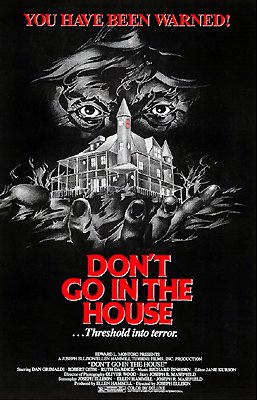
 Don’t Go in the House / The Burning / Pyromaniac (1979/1980) ***½
Normally when people talk about formative movies, they’re also talking about favorites. Movies that they came to early in life, and which they’ve watched again and again until they became the cinematic equivalent of comfort food. It doesn’t always work that way, though. Until I renewed my acquaintance with it for this review, I saw Don’t Go in the House only once, when it aired on “Joe Bob Briggs Drive-In Theater” one Friday night in the late 1980’s. And yet the film had an enormous effect on the turn into darkness that my taste took starting in my mid-teens. I had never seen a movie like Don’t Go in the House, and it enlarged my understanding of the kinds of storytelling that were even possible. Don’t Go in the House showed me that a protagonist could be not merely an antihero, but an all-out villain— and that it was furthermore not necessary for that viewpoint villain to have a single redeeming quality. Conversely, it showed me that a story could dispense with heroes altogether, leaving only victims, witnesses, and bystanders who might or might not have the courage to get involved. This hopeless, bleak, and hostile narrative space is not one where I like to hang out all the time, but it was a revelation to learn that it existed at all. I’m therefore unable to share in the consensus opinion that Don’t Go in the House is a squalid, stupid, hateful exercise in misogyny, exemplifying all the most pernicious tendencies of the horror genre at the turn of the 80’s. It undeniably is squalid, and its vile protagonist is beyond question one of the most noxious misogynists to be found anywhere in fiction, but the revulsion that Donny Kohler rightly inspires in almost everyone who watches the film is precisely the point. In much the same manner as the contemporary Maniac, Don’t Go in the House posits that the most horrifying vantage point from which to take in a story of serial murder is the killer’s own.
30-something Donny Kohler (Dan Grimaldi) is not, in most people’s terms, a successful man. He works at the municipal incineration plant for some town in the orbit of New York City, shoveling garbage into the furnaces for eight hours every day. Although he lives in an impressive Victorian manse atop the hill dominating his neighborhood, the house is a family property inherited from more prosperous ancestors, and it’s falling into dilapidation from the eaves down. Kohler has no real friends, and to all appearances has never had a girlfriend. Most importantly, he not only lives with his obstreperous, elderly mother (Ruth Dardick), but remains as completely under her thumb as he was in his boyhood. And that boyhood, in case this need be said, was not a happy one. Donny’s father died early, and as soon as he was in the ground, Mom transformed into a vengeful tyrant. Her object, or so it seems from the handful of flashbacks we get to see, was to counteract her late husband’s example of moral laxness, and her method was an extreme extrapolation of the idea that God knows best. In a foretaste of the Hell that awaits the unsaved sinner, Mother habitually punished Donny’s misbehavior by holding his forearms over the flames of the kitchen stove. Unsurprisingly, the adult Donny has an idiosyncratic relationship with fire, mixing fascination and terror in equal measure as one tends to do in the presence of something holy.
Bear all that in mind when a fellow trash-burner by the name of Ben (Charles Bonet, from Death Promise and The Black Dragon’s Revenge) gets half-incinerated himself in a workplace mishap one evening right before quitting time. Vito the foreman (Bill Ricci) and another coworker called Bobby Tuttle (Robert Carnegie, of Mother’s Day, who was still calling himself Robert Osth back then) both assume that Donny didn’t do anything to help because he froze in horror, and Kohler tries to convince himself later on that he really did, but the truth is both weirder and more complicated. Donny froze, alright, but it wasn’t out of horror at Ben’s suffering. Although he could never explain this to a man of the sort that runs incinerator plants, what rooted Donny to the spot as Ben burned was more like awe. That was divine judgment playing out before his eyes, and far be it from Donny Kohler to interfere with the work of the Lord. Still, Tuttle rightly recognizes that the incident has left Kohler shaken, and in the days to come, he does his best to offer Donny a kind of friendship that the latter man simply doesn’t know how to accept.
Kohler has an even bigger shock waiting for him at home, however. While he was at work, his mother died peacefully in the middle of her afternoon nap. Donny’s reaction is considerably less peaceful, for however much he feared and resented the old lady, he also hasn’t the foggiest notion of how he’s supposed to function without her. That’s when he first hears the voices. It’s never quite clear who or what the voices are meant to represent beyond madness in some very general way, but they intriguingly sound like several young women speaking in unison. And the first thing they tell Donny is that Mom’s death, whatever else might come of it, means that he’s free. Not only that, it means that he’s Master of the Flame. That reverses the whole power dynamic of the relationship, and when Mother’s voice also speaks up in Donny’s head to try reasserting her authority, Donny’s takeaway is that it’s finally her turn to be punished.
Obviously things are going to be different around the Kohler house from now on, even if Mom’s increasingly charred corpse does remain in her accustomed place in the master bedroom suite. For one thing, Donny starts blowing off his shifts at the incinerator plant. Vito is grudgingly inclined to forgive that at first, on account of that nasty business with Ben, but the foreman’s patience wears thin as the week stretches on. Meanwhile, Kohler embraces his new role as Master of the Flame in truly extravagant style. First he gets an old-fashioned asbestos fire suit of the sort that Ben might have been glad to have, lung cancer be damned. Then he buys an army-surplus flamethrower to go with it. (You would be amazed at the number of U.S. states where that’s legal even today.) Finally, he fireproofs the shit out of a disused room on the second floor of the house, plating every inch of wall, floor, and ceiling with stainless steel atop a thick layer of insulation. Mother’s deteriorating condition suggests that the whole setup was devised at least partly with her in mind, but as Kohler’s insanity progresses, he starts luring single young women back to his house, burning them to a crisp, and ensconcing their bodies (much more primly and traditionally dressed than he found them, you’ll notice) in yet another spare room on the second floor.
The surprising thing is that Donny seems to recognize at some level that this is all a bit much. He begins paying somewhat combative after-hours visits to his old church, and engaging Father Gerrity (Ralph D. Bowman) in debates over the nature of evil and the reality (or lack thereof) of the Devil. And at the same time, he reaches out for the companionship of Bobby Tuttle, who plainly believes that he’s doing a good deed by drawing the workplace weirdo out of his shell. In fact, though, Bobby’s biggest, brightest idea in that direction— taking Donny to a disco on a double date with the two girls with whom he’s been cheating on his wife (Nikki Kollins and Kim Roberts)— gives rise to the situation that sends Kohler all the way over the edge.
I said at the beginning of the review that Donny was a misogynist, and one of the most perceptive things about Don’t Go in the House is that that’s true along multiple vectors at once. First and foremost, he’s motivated to avenge his upbringing, paying the abuse he suffered as a child both back against his mother now that she’s safely dead, and forward against any other woman who makes him feel similarly emasculated. At the same time, he seems, like Ezra Cobb in Deranged, to have absorbed from his mother some disapproval of the modern liberated female. Mind you, this aspect of Kohler’s character is merely implicit. We’re never shown outright just what bees Mother had in her bonnet about immorality, but Donny’s choice of victims is suggestive, as is the fact that he subsequently dresses their corpses in what we’d nowadays call tradwife attire. But there’s also something slippery at work here, something to do with those feminine voices in Kohler’s head, and how they goad him toward his crimes. Notice that after he burns his first three victims, the voices seem to become embodied in their oxidized remains. Again this is only implied, but I think maybe the voices personify a longing that Kohler was unable to acknowledge even subconsciously so long as his mother was alive, and that his initial murders are an attempt to give that longing physical shape by transforming “unacceptable” real women in accordance with some fantasy of ideal womanhood. And if that’s true, it puts an altogether different spin on Donny’s subsequent dreams and visions of the burned bodies coming alive to overwhelm him. Instead of the angry ghosts of the women he killed, perhaps we’re seeing Kohler’s sublimated fears that his perfected love-objects will be as scornful of him as their real, living counterparts.
That examination of Kohler’s psychology brings me to another thing that stood out to me about Don’t Go in the House when I first saw it 30-odd years ago. I’d watched enough movies about serial killers by then to have certain expectations about how they’d be handled on film. Whether they were diabolical geniuses or malevolent comedians or silent, hulking, barely-human monsters, serial killers in the movies were almost always impressive. Even Norman Bates, unassuming as he was, had an unusual skill and a rare psychiatric diagnosis. In the real world, though, serial murder is generally the work of pathetic losers whose crimes are the only remarkable things about them. I’m pretty sure Don’t Go in the House was the first film I ever saw that attempted seriously to portray that, and it’s exceptional for doing so even now.
Even that isn’t the most surprising thing about this movie, though. No, what blows my mind about Don’t Go in the House upon revisiting it is how it manages to have the impact that it does, and to acquire the reputation that it has, even though only the first of Kohler’s murders is depicted onscreen. Most films that leave me feeling like I was kicked by a mule feature a lot of violence, in addition to putting effort and creativity into making that violence as harrowing as possible on a scene-for-scene basis. Don’t Go in the House, however, is a pure case of quality over quantity. Notice, too, that Donny’s modus operandi precludes the use of 80’s horror’s most popular shock tactics. You can’t sneak up on anybody for a jump scare while wearing a flamethrower on your back, and there’s no room for dismemberment or arterial sprays if the victims all die by fire. So how exactly does one stage a fire stunt so as to make it every bit as disturbing as any gore effect from Tom Savini’s glory years? Honestly, I’m torn between wanting to describe this death scene in excruciating detail, and wanting to leave you totally in the dark to be gobsmacked by it out of nowhere like I was. How ’bout I just say that director Joseph Ellison or somebody in his employ devised a way to do a full-body burn on a completely nude actress (Johanna Brushay) as an optical illusion created in-camera, and to make it almost as horridly convincing as just dousing the girl in gasoline and striking a match? Do a thing like that once, at the beginning of the second act, and you truly don’t need to offer up any further physical horrors.

Home Alphabetical Index Chronological Index Contact
