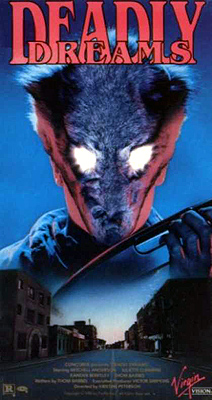
 Deadly Dreams (1988) ***
I remember seeing the box to Deadly Dreams staring up at me from the shelves at various video rental shops back in the day. With that title, and with the awareness that it was a direct-to-video movie of recent provenance, I always assumed that it was a shoddy ripoff of A Nightmare on Elm Street. But although Deadly Dreams does borrow some of that film’s esthetics, it’s something else entirely when it comes to subject matter. What Deadly Dreams reminds me of most, believe it or not, is the Hammer Film Productions Mini-Hitchcocks of the 1960’s, albeit with an era-appropriate update to the surface gloss. As this movie twists and turns its way from its slasher-inspired inciting incident to its darkly ironic conclusion, it partakes variously of the psycho-horror, gaslight conspiracy, and revenge thriller traditions. And although it suffers a tad from the production poverty that always bedeviled the direct-to-video market, Deadly Dreams exhibits considerably more flash and panache than one learns to expect of such a film.
A decade ago, tool and hardware magnate John Torme (C.H.U.D. II: Bud the C.H.U.D.’s Geoffrey Forward) and his wife (Gyl Roland, from Barn of the Naked Dead and Black Gunn) were murdered by Norman Perkins (Duane Whitaker, of Hobgoblins and Leatherface: The Texas Chainsaw Massacre III), the junior partner whom Torme had just forced out of their company. We shouldn’t take the version of events that opens the film altogether literally, though, because it’s really one of the nightmares that have plagued the slain couple’s younger son, Alex (Mitchell Anderson, from All-American Murder and Jaws: The Revenge), ever since. For instance, I rather doubt that Perkins followed up the double murder by donning an ill-fitting wolf mask and hunting the ten-year-old Alex all through the wooded grounds of the Torme mansion, because that seems inconsistent with the shooter turning the gun on himself as he’ll later be said to have done. Also, the sharp-eyed will observe that Perkins’s weapon changes as soon as he puts on the mask from a shotgun to a rifle more appropriate to hunting big game; it’s possible that we’re just looking at a continuity error, but inconsistent details like that are a hallmark of actual dreams, and I’m inclined to give director Kristine Peterson credit for dropping a subtle hint before Alex jerks awake in bed.
Anyway, Alex is in college now, majoring in literature and readying himself for a career as a professional writer. That’s become a persistent point of contention between him and his elder brother, Jack (Xander Berkeley, of The Dark and the Wicked and Candyman), who assumed control of the Tormex Corporation after their father’s death, but has proven to be not so adept a businessman. Jack feels like Tormex could use his kid brother’s creativity, and he’s forever pushing Alex to take his share of the inheritance in company stock when he turns 21 next year, and to assume his “rightful” place at Jack’s side. Alex, for his part, regards the prospect of becoming crown prince to the Hacksaw King of Nowheresville with undisguised horror. Besides, although no one ever comes right out and says this, it’s obvious that writing is the only thing keeping Alex in the same zip code as sanity— and it’s an open question how well even that is working anymore. The wolf-masked hunter that Perkins always becomes in Alex’s nightmares? The poor kid has started catching glimpses of him in waking life as well, observing him from a stealthy distance the way Michael Myers observed Laurie Strode in Halloween.
That’s where things stand on the night when Alex’s best friend, a pill-popping pre-med by the name of Danny (Body Chemistry’s Thom Babbes, who also wrote the screenplay to Deadly Dreams), tries to set him up with dance major Maggie Kallir (Juliette Cummins, from Click: The Calendar Girl Killer and Friday the 13th, Part V: A New Beginning). Although Danny’s matchmaking is unsuccessful on that occasion, Alex eventually persuades the girl to allow him a do-over, at which he manages to behave like neither a turd nor a psycho. (Not having Danny around to act as the world’s worst Cyrano de Bergerac helps considerably.) Mind you, this romance is not going to be without its pitfalls. The couple are obviously doomed to confront Alex’s nightmares whenever Maggie first sleeps over at his apartment, which is apt to throw a new and less flattering light on that “not a psycho” situation. Also, Danny changes his tune about Maggie as soon as her relationship with Alex progresses beyond a one-night stand, claiming suspicions about her motives that he refuses to put into words. And Jack has misgivings of his own, about which he’s considerably less reticent when Alex brings Maggie over to the Torme mansion for dinner one night. Jack thinks Maggie is nothing but a gold-digger, and the girl doesn’t help her case any by walking into the trap that he lays for her, namedropping a fictitious acquaintance on the New York theater scene. Still, Alex has never had a real girlfriend before, and he’s determined to make it work with Maggie regardless of what anyone else has to say on the subject.
It’s worth asking, then, what kind of not-a-coincidence it is when the hunter of Alex’s dreams picks this juncture to step up his previously very muted real-world terror campaign, in ways that cast various flavors of suspicion on everyone in the lad’s life. For instance, whoever cuts the security chain on the door to Alex’s apartment would have a hard time doing so unless they could already get inside by other means. Whoever deposits a dead deer in Alex’s bathtub while he’s out, only to remove it again after he flees the flat in a panic, would need a pretty strong sense for the rhythms of his comings and goings. And frankly it’s hard to imagine anybody but Danny himself being in a position to plant that familiar-looking wolf mask in his closet for Alex to find when he comes over to visit. Alex quickly finds himself not knowing whom to trust— and it’s well within the realm of possibility that the correct answer is “nobody.” That said, it might interest the boy to know that at least one of the conspirators against him has been trusting the wrong person, too.
Kristine Peterson deserves a fan cult. Probably not a very big fan cult, and certainly nothing on the scale of those devoted to, say, George Romero or John Carpenter, but something more modest, like the cults for Jack Hill or Curtis Harrington? Yeah— that sounds about right. Like the latter pair, Peterson has a small but interesting catalog of small but interesting movies, in which she mostly overcomes the handicaps of penurious budgets and unreasonable shooting schedules. Deadly Dreams was her directorial debut, and it’s another case study in the exciting potential that direct-to-video offered in its early days, before the market was largely rolled up by the most cynical hacks in showbiz. Making cheap movies confers a license to take risks, and although I certainly wouldn’t call Deadly Dreams uncommercial, it doesn’t spend much effort chasing the trends of late-80’s horror, either. It had been a long time since gaslight conspiracies were anywhere near the state of the art, and although some of the things that happen in this movie could be taken to tease the possibility of the masked hunter as a supernatural slasher, the real object is to use Alex’s increasing readiness to believe in the resurrection of Norman Perkins as a handy gauge to the progress of his crackup. Similarly noteworthy is the hunter’s singular focus on terrorizing Alex. Deadly Dreams offers not even the most insincere genuflection toward the altar of the body count, tying each of its several murders directly to the killer’s objective. Peterson may not do anything radical here, but the whole film is definitely unfashionable, and that might have taken even more guts.
Deadly Dreams represents a surprisingly self-assured and capable departure from fashion, too, especially for a debut feature. Much like in The Evil Dead, it’s an interesting surprise to see a male protagonist subjected to specific forms of mistreatment that the horror genre usually reserves for women. But whereas Ash was essentially a male Final Girl, Alex is for most practical purposes a male gothic heroine, beset by a conspiracy in which his brother, his lover, and his best friend are all seemingly implicated. And again like Sam Raimi, Peterson seems to take the protagonist’s masculinity as permission to amp up the intensity of the abuse. Alex is a man— he can take it, right? I was also impressed that in 1988, at the height of Just Say No, Deadly Dreams ultimately reveals the pill fiend as the closest thing Alex might have to a reliable ally, while the hands of more outwardly respectable characters get dirtier and dirtier as the film wears on. The most diabolical of the villains, meanwhile, consistently acts the least shady out of everyone, so that the depth of their depravity comes as a genuine shock once it’s finally exposed. In a decade that liked its baddies big and loud, that too was a confident revolt against fashion. I won’t go so far as to call Deadly Dreams a forgotten gem, but it is an unjustly ignored curio, and I warmly recommend it for horror fans old enough to remember feeling left out by where the genre was going in 1988.

Home Alphabetical Index Chronological Index Contact
