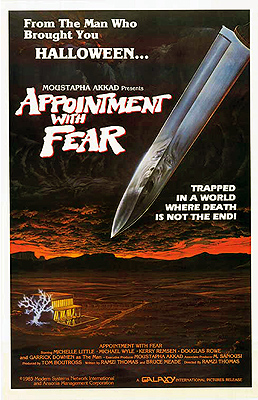
 Appointment with Fear / Deadly Presence (1985) -*½
When I said, in my review of The Astral Factor, that I’d like to see a movie that really was about an astral-projecting killer, I didn’t realize that I was wishing on the monkey’s paw. It turned out, you see, that I had in my collection a hitherto-unwatched pirate copy of exactly such a film— but it was Appointment with Fear, one of the pictures that Moustapha Akkad produced during the fallow years in which it seemed like Halloween III: Season of the Witch had killed off his gravy-train franchise for good. Appointment with Fear is even more stupid, bewildering, and nonsensical than The Astral Factor, and it’s boring, too, for most of its length. But its bulgy-eyed, comatose killer (somebody definitely saw Patrick) does indeed commit his crimes via a quasi-physical manifestation of his wandering spirit while his body lies inert in the asylum for the criminally insane where he’s spent the past several months, so I guess I technically got what I wanted.
I don’t think I’ve ever seen an opening sequence with as many moving parts as the one that kicks off Appointment with Fear. A woman whose name we never will learn (Sergia Simone) slips furtively out her own front door, carrying a bundled-up baby in her arms. She gets into her station wagon and drives off, not realizing that the disreputably rumpled Sergeant Kowalski (Douglas Rowe, from The Legend of Nigger Charlie and Critters 2: The Main Course), who’s spent the entire afternoon spying on her from across the street, planted a homing device in her wheel well. Kowalski follows the woman, but seems not to notice that he’s being followed in turn by an obvious creep (Land of Doom’s Garrick Dowhen) in the requisite unmarked white cargo van, who was also staking out the house. Meanwhile, a pushing-30 teenager named Carol (Michele Little, of My Demon Lover and Radioactive Dreams) is eavesdropping on an old geezer’s birthday party with a parabolic microphone, and recording what she overhears on her boom box. Heather (Kerry Remsen, from Ghoulies II and Pumpkinhead), one of the mimes providing the entertainment at said party, is a friend of hers, but that by itself hardly seems adequate to explain Carol’s behavior. (We will eventually observe that Carol simply carries that fucking contraption everywhere she goes, perving on all and sundry with the kind of singleminded determination that one otherwise expects only from weird nerds in 80’s teen comedies.) In any case, the woman with the baby temporarily gives both of her pursuers the slip, and does something even stranger than what Carol is up to. She hides the child in the bushes of a house a few doors over from the birthday party, then sits down on the front steps. I emphasize that there’s every reason to believe she doesn’t even know whose house that is. Van Creep catches up to her at this point, and Carol’s mic picks up the woman saying that she will not allow him to murder their son before he shanks her in the side with a hunting knife, and goes his merry way. Heather, having now finished pretending to be locked inside invisible boxes for the amusement of a senile birthday boy, goes to see what’s up with the woman bleeding out on the neighbors’ stoop, and makes no objection when the victim points out the baby in the bushes, charging Heather with ensuring his continued safety.
By the time Kowalski arrives on the scene, everybody but the dead woman is gone. Other police, quicker on the draw than the sergant, are looking the place over, led by his former partner (Nick Conti, from The Last Seduction and RoboCop 3). The latter detective helpfully brings us more or less up to speed on what we’ve been watching so far, although it would be exaggerating to say that he makes it make sense. Evidently Van Creep is a known psycho who was convinced that he’d become a vessel for the Phrygian fertility god, Attis (whom Appointment with Fear’s several writers misidentify as an Egyptian deity). He’d been wanting to kill his son ever since the kid was born, on the theory that only such a sacrifice could secure the god’s indwelling for another year, together with whatever boons go along with that. Kowalski got the guy put away not long ago in an asylum for the criminally insane, but the sergeant has been on a hair trigger ever since, anticipating the crazy’s escape; he got to be so obsessed with protecting Mrs. Van Creep whether she wanted it or not that the captain pulled him off the case and placed him on administrative leave. That being so, the present circumstances ought to count as bitter vindication for Kowalski, right? But as it happens, there’s been no escape. In fact, there very obviously never can be an escape, because Van Creep lapsed into a coma yesterday, from which he is not expected ever to emerge. If Kowalski would like to check, he’ll find the nut vegetating away in a remarkably austere hospital bed, staring fixedly at a ceiling that he’ll never truly see again.
A fellow inmate by the name of Little Joe (Mike Gomez, of Locusts and The Caretaker) has some ideas about how all that might be possible, if Kowalski is willing to listen. Remember, the writers think Attis was an Egyptian god, and the Egyptians had a very different understanding of the human soul than we do. Depending on which century we’re talking about, they divided what makes us ourselves into at least five and sometimes as many as eight distinct components, one of which was called the ka. There’s really no good analogue for the ka in Western metaphysics, but it’s sometimes translated as “vital essence,” and it’s one of the spiritual aspects that was supposed to vacate the physical body (or khet) at the moment of death. Also, its hieroglyphic representation was a pair of upraised arms, which suggests that it had something to do with the power to act. That matters, because death wasn’t the only time when the ka left the khet. It also went off on its own during dreams, and some mystics contended that a person could train their ka to act upon the physical world in the ultimate form of lucid dreaming. It’s Little Joe’s opinion that Van Creep has done exactly that, using his wandering ka as a weapon of assassination in the endless dream-state of his coma.
If Little Joe is right, then the ramifications for Heather are obviously rather serious— to say nothing of more mundane concerns like how the fuck she’s supposed to explain running around with some dead stranger’s baby. Fortunately, she has the most oblivious parents this side of Ferris Bueller’s Day Off, and a house-sitting gig this weekend. If nothing else, Heather will have some breathing room to plot her next move. She’ll have plenty of help brainstorming, too, should that become necessary, because she and Carol had already planned to throw a party in the mansion that Heather is supposed to be guarding against exactly that sort of misuse while the owners are away. Both girls will be in attendance, obviously, along with Carol’s omnipresent eavesdropping equipment. The specifically invited guests include two more girls named Ruth (Deborah Voorhees, of Innocent Prey and Friday the 13th, Part V: A New Beginning) and Samantha (Mansion of Blood’s Pamela Bach); Carol’s kinda Judd Nelsony, sorta John Cussacky boyfriend, Bobby (Michael Wyle); and Norman (Danny Dayton, from The Dark Backward and Rock ’n’ Roll High School Forever), the oracular hobo who lives in the bed of Carol’s pickup truck. Plus with any luck, there’ll be other kids wandering into and out of the picture all evening, so that Ruth, Sam, and Heather might all have some chance at getting laid. The trouble, as I’m sure you’ve already observed, is that that sounds as much like the setup for a fourth-rate slasher flick as a fourth-rate Sixteen Candles clone. What if Van Creep’s ka decides to crash the party looking for that baby?
It seems incredible that I’ve never had occasion to talk about Alan Smithee in all these years, but I suppose most people who make the kinds of movies that I normally cover here quickly lose their capacity for professional embarrassment. Although Smithee was credited with directing almost 70 films between 1967 and 1999, there was in fact no such person. Rather, the name was a special kind of shared pseudonym, wielded for 30 years by the Directors’ Guild of America as a statement of disapprobation against meddling producers and studio bosses. When one of the latter took creative control of a film away from a director in ways so egregious that the director could no longer stand behind a film as their own work, the aggrieved party could initiate proceedings with the union to have their name removed from the credits, and “Alan Smithee” put on in its place. Note that we’re not talking merely, or even necessarily, about movies that suck here; the DGA’s position has always been that a director should own their failures along with their successes. To become an Alan Smithee film, a picture needed to be transformed against its director’s will into something fit to be disclaimed under a fairly stringent set of quasi-legal guidelines. Or at any rate, that’s how it used to work; the DGA officially retired Smithee at the turn of the century. The short version is that word got out about who and what he really was, leading wags to start adopting the pseudonym ironically— and once that happened, Alan Smithee ceased to be useful for the union’s purposes. You still see the name from time to time, though, and it still occasionally means what it meant in its heyday.
To the best of my memory, Appointment with Fear is the first Alan Smithee film that I’ve reviewed. The disgruntled director was Ramsey Thomas, whose name nevertheless appeared on the advertising materials under the variant spelling, “Ramzi Thomas.” There’s no telling just what Moustapha Akkad might have added, deleted, or reshuffled after giving Thomas the sack, but it was obviously a lot, and it obviously didn’t meet with the director’s approval. It’s therefore an insoluble puzzle to attribute the blame for this movie fairly— but make no mistake, Appointment with Fear as it comes down to us is a blameworthy film indeed. Its most extraordinary defect is that it manages to be at once so loopy and yet also so dull. If I had been told going in that this film’s protagonist was an adolescent espionage junky with a Crazy Ralph living in the bed of her pickup truck, or that its main action would come down to an astral-projecting wannabe Patrick who thinks he’s the host of an ancient pagan fertility god crashing the climactic party in a Savage Steve Holland movie, I’d have been downright excited! Even if the results both suck and blow, how do you fail to do something amazing with a concept like that? The answer, it turns out, is that you don’t do much of anything at all. For every moment of inspired lunacy in Appointment with Fear (and to be fair, there are a few of those), there are easily fifteen minutes of watching Van Creep’s ka stand around in the dark with a scowl on its face while the kids in the mansion wonder what happened to the most recent person to die. (It should go without saying that no one ever bothers to search for the victims at all seriously.) There are several tedious sequences of Carol perving on people with her parabolic mic to no evident purpose, or of Kowalski’s slovenly habits and loutish demeanor getting him into ostensibly comic trouble. There are at least a couple scenes trying futilely to spin drama and pathos out of Heather’s baffling bond with somebody else’s infant, culminating eventually in an explanation that holds no water at all. So while I have no idea how much of that is Ramsey Thomas’s fault, and how much is Moustapha Akkad’s, I can tell you this: I too would be happy to take any kind of excuse not to sign my name to this piece of shit were I in Thomas’s position.
Home Alphabetical Index Chronological Index Contact
