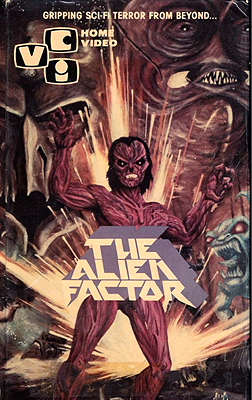
 The Alien Factor (1977/1978) -**½
Before Don Dohler became very slightly famous for making cheap monster movies in the northern suburbs of Baltimore, he was very slightly famous as a fanzine editor. (And before that, he was very slightly famous on the underground comics scene, but that’s a whole ’nother conversation.) Dohler’s zine was called Cinemagic, and as that title might be taken to imply, it looked at movies through the lens of special effects artistry and technique. What made Cinemagic unique was Dohler’s commitment to revealing the tricks of the trade. Although it did sometimes run articles on particular films, or interviews with particular behind-the-scenes personnel, the main focus was on practical tutorials for people with professional or at least semi-pro aspirations. It was a bit like Dick Smith’s Famous Monsters of Filmland Do-It-Yourself Monster Makeup Handbook, except that it came out once or twice every year, and cast a broader net. If you were an aspiring filmmaker, and you wanted to know how to build a stop-motion armature, how to mix fake blood that would look convincing on camera, or how to set up a forced perspective shot, Cinemagic had you covered. The magazine was successful enough that O’Quinn Studios, the publisher of Starlog and Fangoria, bought it from Dohler in 1979— and more importantly, it was good enough that when Tom Sullivan got the job leading Sam Raimi’s effects team on The Evil Dead, he brought his whole Cinemagic collection with him as reference material.
That background stood Dohler in good stead when he set to work on his own debut feature, The Alien Factor, because his readership became his recruitment pool for effects artists. That’s the foremost reason why this junky 70’s retread of the “classic” 50’s Moseying Monster formula is so disproportionately charming. Not only was Dohler spreading the labor of love around, but he was doing it in a way that gave the resulting film real personality. Rather than integrate those readers-turned-collaborators into a single collective, Dohler entrusted each of them to produce a monster of his very own. That doesn’t just mean that The Alien Factor features a wholly unexpected number of extraterrestrial creatures. It also means that each one represents its own distinct design sensibility and skill set, functioning as a plausible proxy for its own distinct home planet. Whatever its faults, The Alien Factor gives you more than your money’s worth of beasties, and it does so with a crazed exuberance of imagination that’s rare even among much bigger and much better-resourced productions.
In a field just outside the dumpy Baltimore County exurb of Perry Hall, teenaged Mary Jane Carter (Nightbeast’s Eleanor Herman) is out parking with her 20-something boyfriend, Rex Walker (then-popular Baltimore rock radio DJ Johnny Walker, who was also in Vampire’s Kiss). Their canoodling is interrupted by a hulking thing like a humanoid beetle, which drags Rex from the front seat of his car, tears him up so badly that the camera will averts its eyes from him forevermore, and injects him full of deadly venom. Mary Jane gets away, but she’s nevertheless in bad shape when she’s picked up later by Sheriff Jack Cinder (Tom Griffith, from Beyond the Wall of Fear and Fiend) and his deputy, Pete (Richard Geiwicz, who was in both Nightbeast and Fiend as well). Although her physical injuries are limited to scratches and bruises sustained while fleeing through the woods, the girl is catatonic with shock.
Cinder takes Mary Jane and what’s left of Rex to the home clinic of Dr. Ruth Sherman (Anne Frith, of Blood Massacre and Maxim Xul) and her nephew, Steven Price (George Stover, from Dracula’s Widow and Harvesters), who is evidently a doctor or at least a nurse practitioner in his own right. Sherman and Price initially agree with the sheriff that attack by a large animal is plausible enough as a tentative cause of death for Walker, but they caution both him and Edie Martin (Mary Mertens), a young hotshot reporter for the local newspaper, that they can’t commit to any theory until after they’ve completed a full autopsy. Cinder then issues a caution of his own while getting the word out about a possibly dangerous wild animal in the vicinity, because the one thing he wants less than a homicidal bear on the loose is a dozen drunken yahoos stumbling around the woods, shooting at anything that moves. The sheriff’s plea to leave it to the professionals makes no impression, however, on Clay (Christopher Gummer, from Curse of the Cannibal Confederates), Ernie (Dohler himself), Richie (Alien Factor editor Dave Ellis, whose other onscreen credits include Blood Circus and The Death of Poe), and Susan (Margie Van Tassell), as perfect a bunch of Baltimore County doofi as ever you’ll see. The boys all get themselves killed by the monster forthwith, but the girl once again makes it out alive.
Susan, unlike Mary Jane, retains enough of her senses to report the true nature of the attacker. Mind you, neither Jack nor Pete takes her monster story at face value, and Mayor Bert Wicker (Dick “Count Gore de Vol” Dyszel, of Chainsaw Sally and Stakes) practically laughs it off when he hears about it. Wicker isn’t laughing about the deaths themselves, though— not least because the area where they occurred is right next to the site of a proposed entertainment complex, the construction of which is supposed to be the crowning achievement of his administration. Wouldn’t do to have a multi-million-dollar development deal fizzle out because the neighboring wildlife won’t stop killing people, now would it?
But while the authorities are going about their work refusing to believe in one monster, we’re seeing that Perry Hall is actually playing host to several of the things. In addition to the venomous beetle-man, there’s something that resembles a gym-rat teddy bear with strangely articulated and freakishly long legs, which kills a drunk (Dave Geatty) in his own home after a night out watching a preserved-in-amber paisley-rock band at the local tavern. There’s an unseen and possibly invisible whatsit that drains the lifeforce out of Ed Miller (Tom Malanowski, who went on to become a notable B-movie editor after a brief Baltimore-based filmmaking career of his own), reducing him to a wizened mummy which so flummoxes Dr. Sherman that she’s momentarily willing to consider a hitherto unknown adult-onset form of progeria. And there’s a fourth creature with the appearance of a flayed man, which comes to Perry Hall in a spacecraft something like an Apollo mission lunar lander. Despite being by far the most horrid of the lot, Mr. No Skin seems to have a more benign disposition than his fellows, for his first interaction with the locals is to heal the wounds of a woman (Debbie Pietron) hurt in a hit-and-run motorcycle accident.
That’s about when an out-of-towner calling himself Benjamin Zachary (Don Leifert, from Crawler and The Galaxy Invader) pays a visit to Mayor Wicker. Zachary says that he works for the Garrett Observatory in Harford County, an hour and change by car to the southwest. The other night— indeed, right about when Perry Hall’s monster troubles began— he observed a large meteor streaking overhead on a trajectory that should have put its point of impact somewhere in the woods outside of town. And although Wicker has hardly distinguished himself as an imaginative thinker thus far, he’s quick to see the connection between the timing and placement of Zachary’s space rock and the current epidemic of unexplained deaths. When he introduces the newcomer to the sheriff as someone who might be able to help, however, Jack makes a connection of his own that escapes Bert even now: isn’t it rather odd that an astronomer, of all people, is so eager to insert himself into what Cinder is still thinking of as police business? I mean, if you’d chased a meteor all the way from Harford County to Perry Hall, wouldn’t you rather just go find the thing, and not get mixed up in a string of weird killings? Also, what’s all this “special equipment” that Zachary says he brought with him that will enable him to succeed where Jack and his deputies have so far failed? Clearly this guy knows more than he’s letting on, and the sheriff isn’t so sure he likes that.
Although it didn’t initially seem like it, Don Dohler picked an awfully good time to make The Alien Factor. True, it never got more than a token theatrical release, and it went over poorly at the handful of screenings it received from exhibitors desperate enough to book it in Baltimore and New York. But the seismic popularity of Star Wars created a huge and hungry market in television syndication for anything that could be passed off as science fiction— even a sleepy little monster flick shot mainly in its director’s basement and backyard. Selling the TV rights to The Alien Factor didn’t exactly make Don Dohler’s fortune, but Gold Key Entertainment (the same outfit that distributed most of Sid and Marty Krofft’s freaked-out kiddie shows) paid enough not only to erase whatever debts were still outstanding from its production, but to furnish Dohler with the seed capital for his next movie, Fiend, as well.
The Saturday night fever dream timeslot on UHF television was the perfect delivery system for The Alien Factor, too. I can confirm this, for that’s how I originally encountered it. Dohler made it to the late 70’s with his 50’s Monster Kid sensibilities intact, so there was nothing in the film that needed cutting to placate Standards and Practices. Believe it or not, The Alien Factor got a G-rating from the MPAA for its extremely truncated theatrical run! So right off the bat, there’s something unsettling about seeing a movie shot outside of Baltimore in the mid-1970’s comport itself like one shot in the environs of Los Angeles 20 years earlier. But then all those bonus monsters show up— before any potential explanation for them is established, I might add— and suddenly you wonder if The Alien Factor is really as 50’s as it seems. After all, space invaders and atomic miscreants generally descended on Bronson Canyon one by one back in the day.
The unexpected oddities proliferate from there. Minor characters drift into the film mostly to become monster chow, but then even the few that survive their encounters with alien lifeforms drift right back out again rather than joining the cast in a meaningful way. Bert Wicker spends much of the film under the misapprehension that he’s the mildly crooked mayor in a shitty Jaws ripoff, further distorting The Alien Factor’s genre affinities. The pacing undergoes strange accelerations and decelerations, too, although that turns out to be the film’s most readily explicable peculiarity. The initial cut proved too short to release, so Dohler had to invent pickup scenes in order to stretch the movie out. Thus, for example, the discovery of Ed Miller’s body by a trio of children is preceded by a curiously elegiac sequence of the kids playing catch in slow motion as the sun descends toward the horizon. Thus also the addition of forgotten Baltimore rockers Atlantis to the scene introducing the long-leggedy alien’s first victim, and the greatly extended nighttime ride of the biker whose only narrative function is to run down the girl whom Mr. No Skin miraculously heals. Finally, the whole production is unmistakably amateur in both senses of the word, the work of people with very little idea what they’re doing, but who are doing it anyway for the sheer love of it. It all combines to make The Alien Factor feel not entirely real, so that you start mistrusting your memories of seeing it almost as soon as the closing credits wind to a stop.

Home Alphabetical Index Chronological Index Contact
